
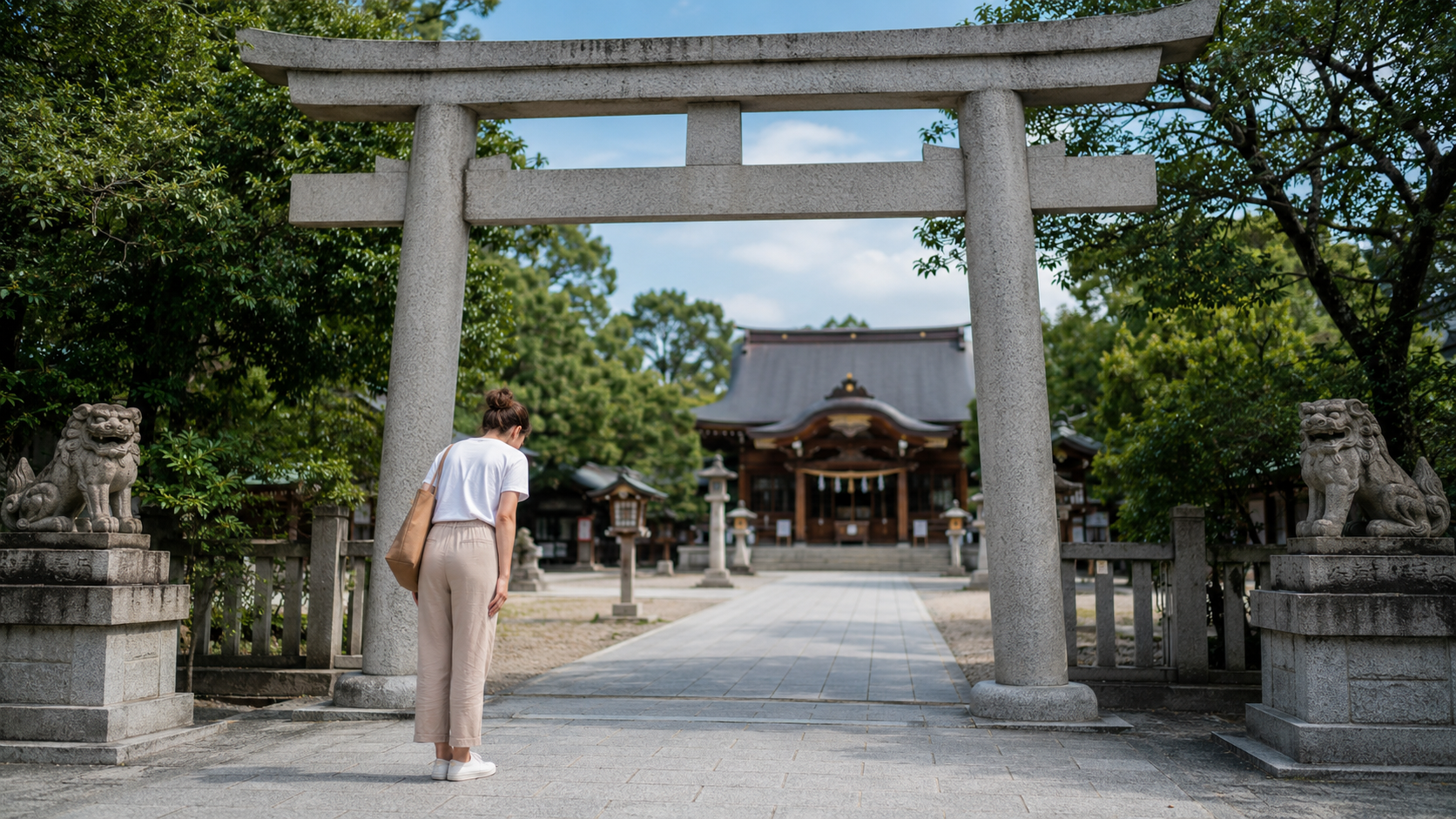
Do You Have to Bow at a Torii Gate?
You arrive at a Shinto shrine in Japan and see a torii gate ahead.
The person in front of you stops.
- They bow.
- Then they walk through.
- Now you may be wondering:
Am I supposed to do that too?
The short answer is:
Bowing before passing through a torii gate is a traditional and respectful custom—but you do not need to panic if you forget.
It is a small gesture that acknowledges that you are entering a sacred space.
Here is what the bow means, how to do it, and what happens if you simply walk through.
Why Do People Bow at a Torii Gate?
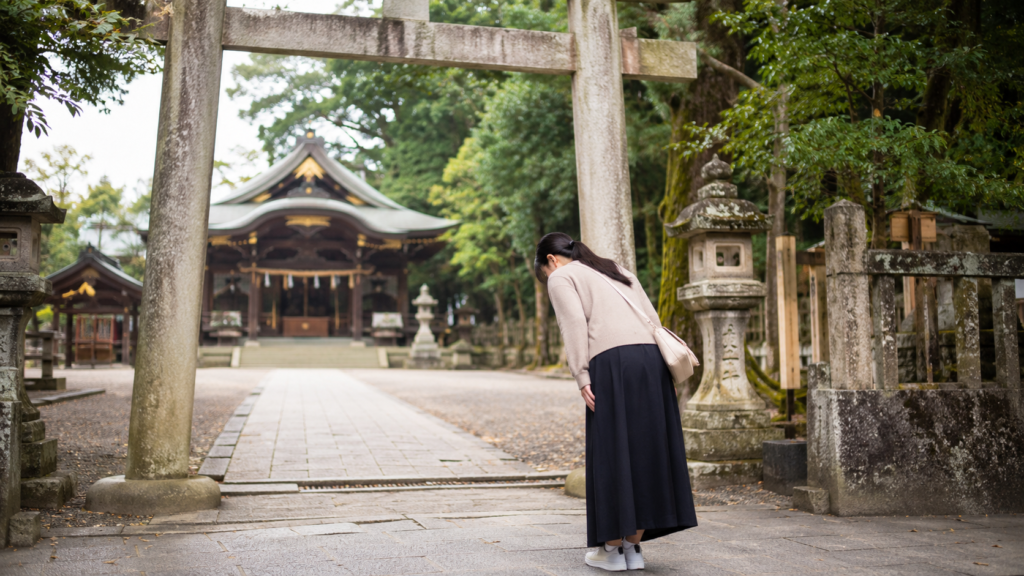
A torii is more than an entrance gate.
It marks a boundary.
The Association of Shinto Shrines explains that a torii separates the sacred precinct of a shrine from the ordinary world outside. Once you pass through it, you are entering an area regarded as sacred.
That helps explain the bow.
You are not bowing to the gate itself as though the wooden or stone structure were the object of worship.
The bow is better understood as a small gesture of respect as you enter the shrine’s sacred space.
The Tokyo Association of Shinto Shrines compares the attitude to visiting the home of someone you deeply respect: you compose yourself, acknowledge where you are entering, and then proceed inside.
If you want to understand the gate itself in more detail, see:
Do You Actually Have to Bow Before Entering?
Not in the sense of an absolute rule.
The Tokyo Association of Shinto Shrines explicitly explains that shrine-visiting etiquette does not have rigid rules that apply identically in every situation, and that ways of showing respect may vary between shrines and regions. It presents bowing before the torii as a polite way to enter.
The Association of Shinto Shrines’ English guidance similarly says that many people pause and bow their heads slightly before walking through the torii.
So it is useful to think of the bow as:
traditional and respectful, rather than compulsory.
If you know the custom, a small bow is a thoughtful way to enter.
If you forget, you have not ruined your shrine visit.
How Should You Bow at a Torii Gate?
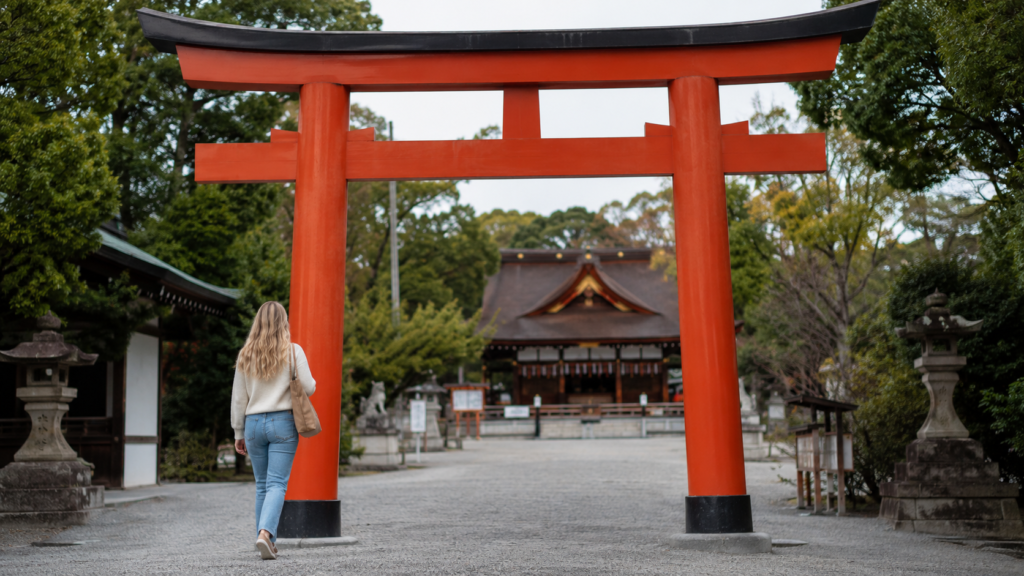
You do not need to perform the deep bows used during the formal prayer ritual in front of the shrine.
A small bow or slight inclination of the head is appropriate when entering through the torii.
Official guidance from both the Association of Shinto Shrines and the Tokyo Association of Shinto Shrines describes this entrance bow as a slight or shallow bow.
A simple way to do it is:
- Pause briefly before the torii.
- Face toward the shrine grounds.
- Give a small bow.
- Pass through calmly.
That is enough.
There is no need to turn a simple gesture into something complicated.
What If You Forget to Bow at the Torii?
Just continue your visit.
You do not need to walk back outside and enter again.
You do not need to apologize aloud.
And you do not need to worry that your later prayer somehow no longer counts.
The bow is a way of showing respect when entering the shrine grounds. Official shrine etiquette guidance describes the custom, but it does not say that visitors who forget it must restart their visit.
If you remember at the next torii or the next time you visit a shrine, you can bow then.
Shrine etiquette is much easier to understand when you think of it as a collection of respectful gestures rather than a list of traps waiting for you to make a mistake.
Should You Bow When Leaving the Shrine Too?
Yes, if you want to follow the traditional etiquette.
After finishing your visit and passing back through the torii, you can turn toward the shrine and give another small bow before leaving.
The Tokyo Association of Shinto Shrines and the Association of Shinto Shrines both describe turning back toward the shrine and bowing when leaving as a respectful practice.
Meiji Jingu also notes that visitors can be seen bowing when passing through torii as they enter and leave the shrine precincts.
A simple sequence is therefore:
Entering:
Small bow → pass through the torii.
Leaving:
Pass through the torii → turn toward the shrine → small bow.
Again, this is a gesture of respect, not something to become anxious about.
Do You Have to Bow at Every Torii Gate?
This is where many simple shrine etiquette guides become less helpful.
Some shrines have only one obvious torii.
Others have several.
The Association of Shinto Shrines explains that the outermost torii marks the entrance to the sacred shrine precinct, while some shrines have additional torii closer to the main sanctuary that mark entry into increasingly sacred areas.
However, I could not find a nationwide rule in the official guidance I checked stating that an ordinary visitor must bow at every single torii encountered within a shrine.
Practices can also differ by shrine.
So you do not need to panic when you suddenly see three more torii ahead of you and wonder whether your trip has turned into a bowing endurance test.
If the shrine provides instructions, follow them.
Otherwise, a respectful approach is more important than obsessively counting gates.
What About Shrines With Rows of Torii?
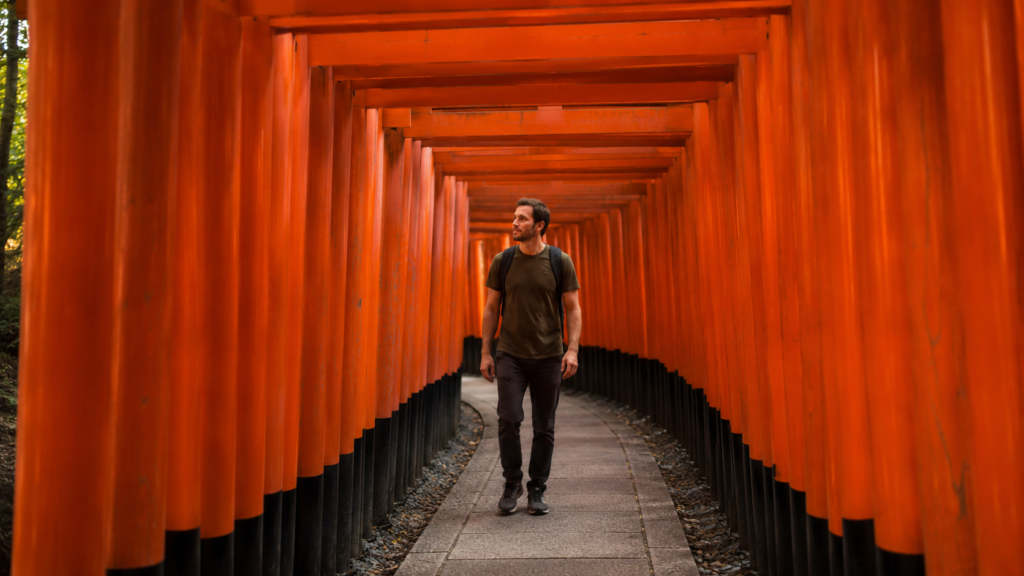
Some shrines have long sequences of torii rather than a single entrance gate.
In situations like these, trying to stop and bow separately at every gate may clearly not make practical sense.
There is no general nationwide instruction in the official sources reviewed for this article requiring visitors to stop at every torii in a continuous row.
The better principle is to pay attention to the individual shrine and its layout.
A torii can mark a boundary into sacred space, but torii are used in different configurations at different shrines. The Association of Shinto Shrines notes that their forms and arrangements vary considerably.
When in doubt, follow signs, shrine staff, and the way the space is intended to be used.
Should You Walk Through the Center of the Torii?
You may notice that people who bow at the torii also avoid walking directly through its exact center.
These customs are related, but they are not exactly the same thing.
Some visitors avoid the center of the shrine approach as a gesture of respect because the central line may be regarded as seichu (正中), associated with the position or path of the kami.
The Association of Shinto Shrines explains that avoiding the center is a recognized way of expressing respect—but also specifically says that there is no strict rule governing how visitors must walk along the approach.
So you may see people:
- bow before entering,
- walk slightly to the left or right,
- and then continue toward the shrine buildings.
These are connected expressions of respect, not rigid restrictions.
What If the Torii Is Crowded?
Use common sense.
Shrines can become extremely busy, especially during festivals or seasonal visits.
The Association of Shinto Shrines specifically warns visitors not to become so focused on etiquette that they ignore a shrine’s own rules or collide with other visitors while trying to follow a particular custom.
That is a surprisingly useful piece of advice.
If stopping suddenly in a packed entrance would cause a problem, do not create one merely because you are trying to execute perfect shrine etiquette.
Respect includes being considerate of the people around you.
Can You Bow at a Torii If You Are Not Shinto?
Yes.
You do not need to identify as Shinto to follow shrine etiquette.
The Association of Shinto Shrines states that there are no specific restrictions preventing people of other religions or beliefs from entering shrine grounds. Visitors are simply asked to respect the dignity of the sacred space and approach the kami politely and sincerely.
A bow at the torii can therefore be understood as a cultural gesture of respect toward the place you are entering.
You do not need to make a declaration of religious belief before doing it.
For more on this:
Is It Disrespectful to Visit a Shrine If You’re Not Shinto?
The Bow Is Really About Changing Your Mindset
There is another way to think about the torii bow.
Before the gate, you may have been checking Google Maps, talking with friends, looking for a vending machine, or wondering where you left your train ticket.
Then you reach the torii.
You pause.
You bow.
And for a moment, you become aware that you are entering somewhere different.
The official explanation from the Tokyo Association of Shinto Shrines describes bowing before the torii not simply as a physical motion, but as a way of composing yourself before entering the precinct.
That may be more useful than thinking:
“I have to bow here because the rules say so.”
The movement is tiny.
The change in attitude is the important part.
Before Your Shrine Visit
Visiting Shrines in Japan for the First Time?
Shrine etiquette can feel simple when you read about it at home—but much harder when you are actually standing at the shrine, wondering what to do next.
And what should you know about goshuin, omamori, and common mistakes visitors sometimes make?
I created a Japanese Shrine Etiquette Guide for first-time visitors to make these customs easier to understand before and during your trip.
It includes simple visual explanations of torii gate manners, temizu, prayer steps, photography etiquette, goshuin, omamori, and common mistakes to avoid.
You can keep it on your phone while traveling in Japan, so you do not have to remember everything at once.
See the Japanese Shrine Etiquette Guide on EtsyFrequently Asked Questions
Do you have to bow before entering a torii gate?
Bowing before a torii is a traditional way of showing respect as you enter sacred shrine grounds. However, official shrine guidance presents it as respectful etiquette rather than an absolute requirement.
How many times should you bow at a torii gate?
A single small bow is the usual entrance gesture described by shrine etiquette guidance. This is different from the deeper bows used during prayer at the worship hall.
Do you bow before or after walking through a torii?
When entering, bow before passing through. When leaving, you can pass through, turn back toward the shrine, and bow again. The Tokyo Association of Shinto Shrines describes both practices.
What happens if you forget to bow at a torii?
You can simply continue your visit respectfully. The official guidance reviewed for this article does not instruct visitors to restart their visit if they forget the entrance bow.
Do you have to bow at every torii in a shrine?
Some shrines have multiple torii marking different sacred boundaries. However, I found no nationwide official rule stating that ordinary visitors must stop and bow at every torii. Follow any instructions provided by the individual shrine.
Why do Japanese people bow at torii gates?
The torii marks the boundary between the ordinary world and the sacred shrine precinct. Bowing is a small gesture acknowledging that transition and showing respect before entering.
Final Thoughts
So, do you have to bow at a torii gate?
It is better to think of it as a respectful custom than a compulsory rule.
A torii marks the transition into sacred shrine grounds, and a small bow gives you a moment to acknowledge that you are entering a different kind of space.
If you remember, bow.
If you forget, do not panic.
If the shrine has its own instructions, follow them.
And when you leave, turning back toward the shrine for one final small bow is a simple way to close your visit respectfully.
Shrine etiquette becomes much less intimidating when you understand the meaning behind the actions.
You are not trying to pass a test.
You are simply showing consideration for the place you are visiting.
Continue Your Journey
A torii is the beginning of a shrine visit, but there is much more to discover once you step through it.
If you’d like to understand the customs, beliefs, and objects you encounter inside a Japanese shrine, these guides are a good place to continue your journey.
- What Is a Shinto Shrine?
- What Is Shinto?
- Who Are the Kami?
- Shrine vs Temple in Japan
- What Is a Torii Gate?
- What Is a Temizuya?
- How to Pray at a Japanese Shrine
- What Is an Omikuji?
- What Is an Omamori?
- What Is a Goshuin?
Before You Go
Keep a simple shrine etiquette guide with you.
If you want to review torii gate manners, temizu, prayer steps, photography etiquette, goshuin, omamori, and common mistakes before your visit, Jin-journey’s English PDF guide is available on Etsy.
See the Japanese Shrine Etiquette Guide on Etsy