
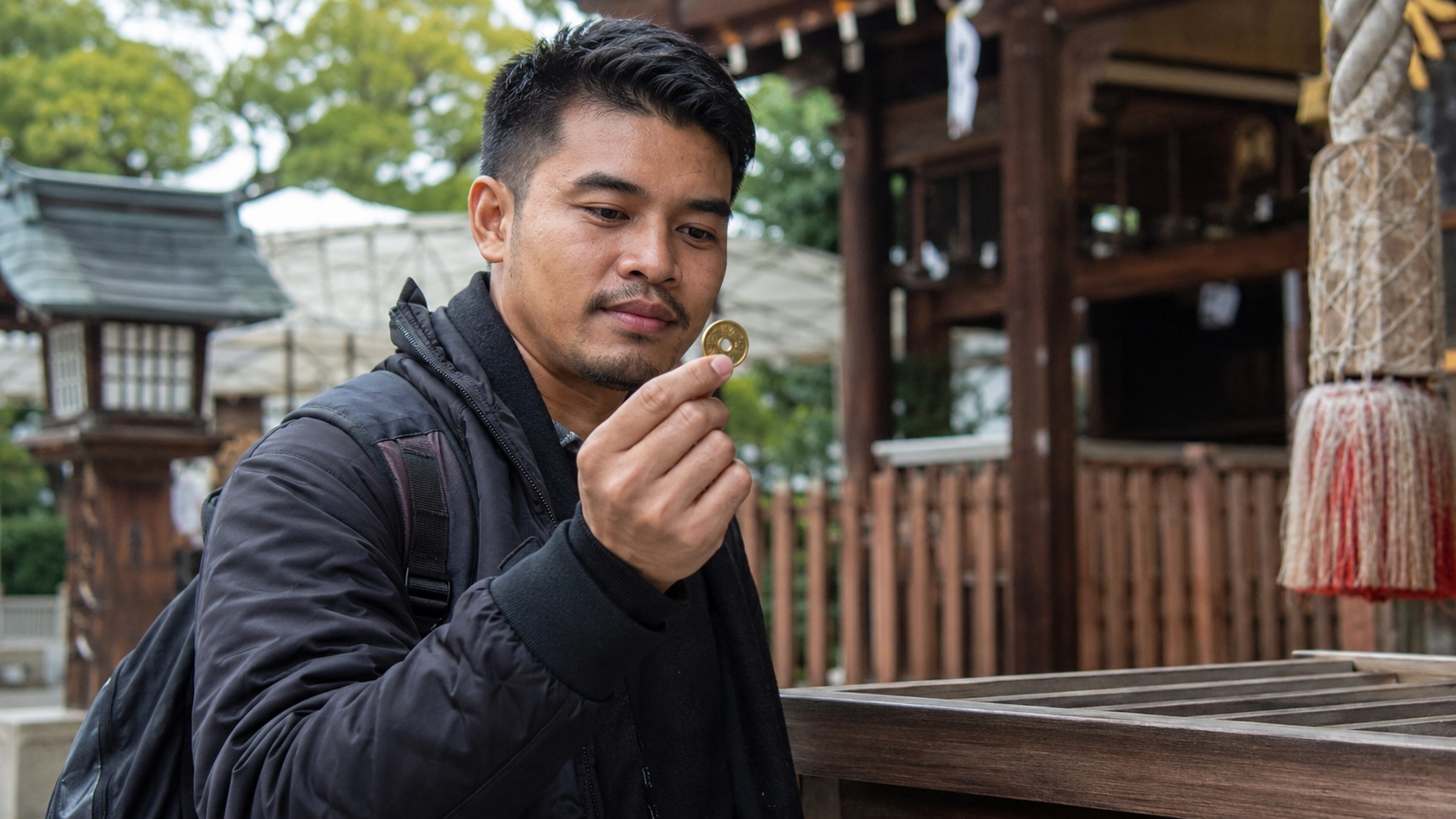
Do You Really Need a 5-Yen Coin at a Shrine?
You are standing in front of a shrine in Japan, ready to pray.
You reach into your wallet.
100 yen.
10 yen.
Another 100 yen.
But no 5-yen coin.
And then you remember something you read online:
“You should offer 5 yen at a Japanese shrine.”
So…does it matter?
The short answer is:
No. You do not need a 5-yen coin to pray at a Shinto shrine.
Five yen is popular because of a playful connection between the Japanese words for five yen and good connections or relationships.
But there is no official rule saying that the kami prefer one coin over another.
In fact, the Association of Shinto Shrines states clearly that there is no prescribed amount for a monetary offering. What matters is the feeling with which it is offered.
So if all you have is 10 yen, 50 yen, 100 yen—or another amount—you can still pray.
The kami are not checking your change.
Why Is 5 Yen Considered Lucky?
The reason is a Japanese pun.
Five yen is:
五円 — go-en
And the word ご縁 — goen refers to a connection, relationship, or bond.
Because they sound the same, putting a 5-yen coin into the offering box came to be associated with hoping for good connections.
Those connections do not necessarily mean romance.
En can refer more broadly to the relationships and circumstances that connect people, places, opportunities, and events.
So the idea behind a 5-yen offering is often expressed as something like:
“May I be blessed with good connections.”
The Association of Shinto Shrines itself mentions the familiar custom of offering 5 yen in the hope of goen.
But the important part comes immediately afterward.
It also says that there is no formally prescribed amount for saisen.
The pun is a custom.
It is not a religious requirement.
So Is 5 Yen Better Than 100 Yen?
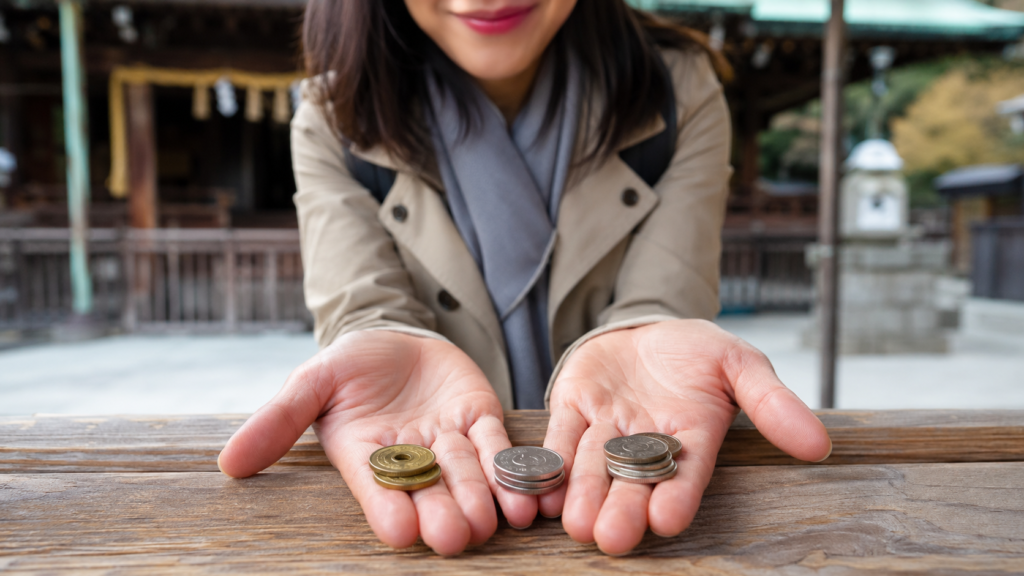
No.
There is no official ranking in which a 5-yen coin gives you better luck than a 100-yen coin.
And offering more money does not mean that your prayer becomes more powerful.
The Association of Shinto Shrines explains that the important thing is not the amount or the wordplay attached to it, but offering it to the kami with sincerity.
This is worth remembering because Japanese websites—and sometimes Japanese people themselves—have created all kinds of playful “lucky offering amounts.”
They can be fun.
But they should not be confused with official Shinto rules.
Other Lucky Offering Amounts You May Hear About
This is where Japanese wordplay gets entertaining.
There are many popular combinations based on the sounds of numbers and words.
5 yen — “Goen”
The classic one.
5 yen → go-en → ご縁
A wish for good connections.
This particular wordplay is even acknowledged by the Association of Shinto Shrines as something people commonly do.
25 yen — “Double Goen”
Another popular folk interpretation is:
25 yen → 二重のご縁 — niju no goen
or “double good connections.”
This appears in numerous modern guides to lucky offering amounts in Japan.
It is a bit of playful numerology rather than an official shrine teaching.
In other words:
You can use 25 yen if you like the idea.
But you do not get twice as much divine attention for it.
45 yen — “Good Connections Always”
This one is particularly well known:
45 yen → 始終ご縁 — shiju goen
It plays on words to suggest having good connections all the time.
The Association of Shinto Shrines mentions both the 5-yen and 45-yen wordplays when explaining that people sometimes choose offering amounts this way—but again emphasizes that there is no official amount.
10,000 yen — “Everything Goes Harmoniously”
You may also come across the idea that a 10,000-yen offering represents:
万事円満 — banji enman
roughly, “may everything be settled harmoniously.”
Another popular explanation plays with 万円 (man-en, ten thousand yen) and 円満 (enman, harmony or completeness).
This interpretation appears in modern Japanese guides to auspicious offering amounts.
But this should be treated as folk wordplay, not an official Shinto teaching.
And no—you certainly do not need to put ¥10,000 into the offering box just because it sounds auspicious.
Your ¥5 coin is not the budget option and ¥10,000 is not the premium prayer package.
What About 1,000 Yen and “Infinite Blessings”?
You may see claims online that 1,000 yen is lucky because the number 1,000 represents endless or infinite blessings.
I could not verify this as an established Shinto belief or shrine tradition in authoritative shrine sources.
A recent non-official Japanese website makes this claim, but that alone is not enough to treat it as a traditional meaning attached to shrine offerings.
So if you see this explanation online, it is better to think of it as modern popular numerology whose origin is unclear, rather than established shrine etiquette.
That distinction matters.
There are plenty of fun superstitions and wordplays surrounding shrine visits in Japan—but not all of them come from Shinto itself.
What Is Saisen Actually For?
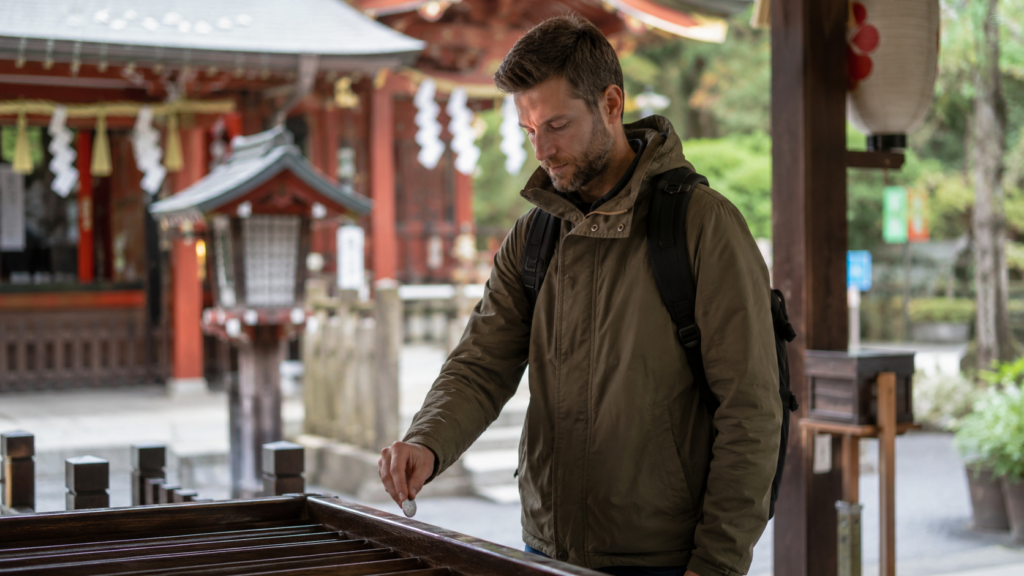
The money placed in the offering box is called saisen (賽銭).
But monetary offerings are not where the tradition began.
The Association of Shinto Shrines explains that people traditionally offered products of the mountains and sea to the kami, with rice holding particular importance. Rice could also be wrapped in white paper and presented as an offering.
As money became more widely used, coins gradually came to be offered as well.
So saisen is better understood as an offering expressing gratitude than as payment for a wish.
That makes the obsession with finding the “correct” coin seem a little different.
The question is not really:
“How much does this prayer cost?”
It is:
“What do I want to offer?”
How Much Should You Offer?
Whatever amount feels appropriate to you.
Seriously.
There is no official minimum.
There is no lucky amount you must use.
And there is no need to stand in front of the offering box trying to calculate the most spiritually efficient combination of Japanese coins.
If you have a 5-yen coin and enjoy the goen wordplay, use it.
If you have 100 yen, that is fine.
If you have another amount, that is fine too.
The amount is flexible.
But there is one practical thing international visitors should know: the currency matters more than the denomination.
Can You Use Foreign Coins as an Offering?
If you are visiting Japan from overseas, you might be tempted to place a coin from your own country into the offering box.
It is better not to.
There is no rule saying that your offering has to be a 5-yen coin—or even a particular amount—but when making a monetary offering at a shrine in Japan, use Japanese yen whenever possible.
Foreign coins create a practical problem for shrines.
They have to be separated from Japanese currency, and many foreign coins cannot simply be deposited or exchanged in the same way as Japanese coins.
Some shrines therefore specifically ask visitors not to place foreign currency in their offering boxes.
For example, Koshikiiwa Jinja in Hyogo has explained that foreign coins must be sorted separately from other offerings and that this creates additional work for the shrine, asking visitors to avoid using them when possible.
Foreign coins do sometimes end up in shrine and temple offering boxes. Organizations such as the Nara branch of UNICEF even provide a system through which separated foreign coins can be collected and donated.
But that does not mean you should deliberately use foreign currency as saisen.
If you do not have a 5-yen coin, another Japanese coin is perfectly fine.
10 yen, 50 yen, 100 yen—it does not need to be the “lucky” coin.
And if you have no Japanese cash at all, there is no reason to substitute a coin from home just because you feel you must put something into the offering box.
A Simple Rule for Travelers
The amount is up to you. The currency should be Japanese yen.
That is probably the easiest way to remember it.
Don’t Throw Your Coin as Hard as You Can
There is another small point worth knowing.
You will often see coins tossed into the offering box.
But you do not need to launch your coin from several meters away.
The Association of Shinto Shrines notes that throwing money into the box has been associated with different interpretations, including offering to a local deity and purification, but recommends handling the offering respectfully because it is an expression of gratitude.
So there is no need to test your pitching arm.
Place or toss the coin in gently.
Then continue with your prayer.
If you are not sure what comes next, see:
How to Pray at a Japanese Shrine
Saisen and Hatsuhoryo Are Not Quite the Same Thing
There is one useful distinction for travelers.
The loose coin you put into the offering box when praying is saisen.
When you receive things such as an omamori or make certain offerings at the shrine office, you may see the word hatsuhoryo (初穂料).
Historically, hatsuho referred to the first harvested ears of rice offered to the kami in gratitude. Today, money is also offered in this way. The Association of Shinto Shrines explains that monetary hatsuhoryo continues this idea of making an offering to the kami.
That is why, culturally, handing over ¥1,000 for an omamori does not feel exactly the same as buying a ¥1,000 souvenir in a shop.
You are receiving something from the shrine while making an offering.
That difference also helps explain one small piece of etiquette that can be useful when traveling.
Should You Have the Exact Amount for Omamori and Goshuin?
If possible, yes.
But this needs some nuance.
It is not a universal rule that receiving change at a shrine is forbidden.
Different shrines operate differently.
However, some shrines explicitly ask visitors to prepare the exact amount.
For example, Iwashizu Jinja asks people receiving goshuin to pay the hatsuhoryo without requiring change.
Seimei Jinja similarly asks visitors receiving prayers to prepare their offering so that no change is necessary.
So if a shrine can give you change, asking for it is not automatically some terrible breach of etiquette.
Japanese visitors do it too.
But if you can prepare the exact amount, it is considerate and often makes things easier for the shrine office, especially when it is busy.
There is also a cultural reason behind the preference: hatsuhoryo is understood as an offering rather than simply a retail payment.
So “exact change when possible” is a good habit.
Not a rule to panic about.
A Practical Cash Tip for Your Japan Trip
If you mostly use cards or your phone while traveling in Japan, you do not need to start carrying a bag full of coins just for shrine visits.
But here is one practical habit:
When you do pay with cash, keep some of the Japanese coins and ¥1,000 notes you receive as change.
They can come in handy later for:
- saisen at the offering box,
- omamori,
- goshuin,
- omikuji,
- and other shrine offerings.
You do not need to hunt specifically for a 5-yen coin.
Having a few denominations of Japanese yen is much more useful.
And one more thing: avoid using leftover coins from your own country as shrine offerings. Some shrines specifically ask visitors not to use foreign currency because it has to be separated and can be difficult to process.
So if you happen to get a 5-yen coin as change during your trip, keep it if you like.
But if you do not?
Any Japanese denomination is fine.
Visiting Shrines in Japan for the First Time?
Shrine etiquette can feel simple when you read about it at home—but much harder when you are actually standing at the shrine, wondering what to do next.
How should you pass through a torii gate?
How do you use the temizuya?
What is the proper way to pray?
When is it okay to take photos?
And what should you know about goshuin, omamori, and common mistakes visitors sometimes make?
I created a Japanese Shrine Etiquette Guide for first-time visitors to make these customs easier to understand before and during your trip.
It includes simple visual explanations of torii gate manners, temizu, prayer steps, photography etiquette, goshuin, omamori, and common mistakes to avoid.
You can keep it on your phone while traveling in Japan, so you do not have to remember everything at once.
Before You Visit a Shrine
Visiting Shrines in Japan for the First Time?
Shrine etiquette can feel simple when you read about it at home—but much harder when you are actually standing at the shrine, wondering what to do next.
And what should you know about goshuin, omamori, and common mistakes visitors sometimes make?
I created a Japanese Shrine Etiquette Guide for first-time visitors to make these customs easier to understand before and during your trip.
It includes simple visual explanations of torii gate manners, temizu, prayer steps, photography etiquette, goshuin, omamori, and common mistakes to avoid.
You can keep it on your phone while traveling in Japan, so you do not have to remember everything at once.
See the Japanese Shrine Etiquette Guide on EtsyFrequently Asked Questions
Do you need a 5-yen coin at a Japanese shrine?
No. There is no officially prescribed amount for saisen. Five yen is popular because go-en (“five yen”) sounds like goen, a word associated with connections or relationships. The Association of Shinto Shrines says the feeling behind the offering is more important than its amount or wordplay.
Is 5 yen luckier than 100 yen?
There is no official Shinto teaching saying that 5 yen brings more luck than 100 yen. The association between 5 yen and good goen is a popular wordplay, not a rule.
Can I offer 10 yen at a shrine?
Yes. There is no official rule prohibiting a 10-yen offering. You may encounter popular superstitions based on number puns, but the Association of Shinto Shrines states that the amount itself is not prescribed.
What does 25 yen mean as a shrine offering?
A popular modern wordplay interprets 25 yen as nijū no goen, or “double good connections.” This is a folk interpretation rather than an official shrine rule.
How much money should I offer at a Japanese shrine?
There is no required amount. Choose an amount you feel comfortable offering. According to the Association of Shinto Shrines, sincerity is more important than the amount.
Should I have exact change when getting an omamori or goshuin?
It is a good idea when possible. Some shrines specifically ask visitors to prepare hatsuhoryo without requiring change, although practices differ between shrines.
Can I put a foreign coin in a Japanese shrine offering box?
It is better not to. Some shrines ask visitors to avoid foreign coins because they must be separated from Japanese currency and can be difficult to process. Use Japanese yen instead. You do not need a 5-yen coin specifically—another Japanese denomination is fine.
Final Thoughts
So, do you really need a 5-yen coin at a Japanese shrine?
No.
Five yen is popular because of a charming Japanese wordplay connecting go-en with goen, or good connections.
And if you enjoy that little tradition, there is nothing wrong with saving a 5-yen coin for your next shrine visit.
But the coin itself is not the point.
You might offer 5 yen.
You might offer 25 yen because you like the idea of “double connections.”
You might simply use the 100-yen coin that happens to be in your pocket.
What matters more is why you are making the offering in the first place.
Saisen grew from a tradition of offering something with gratitude to the kami—not from a system where a particular coin buys better luck.
So enjoy the wordplay.
Keep a few coins handy.
And do not let the search for the “perfect” offering distract you from the shrine you came to visit.
Before Your Shrine Visit
Want to feel more prepared at the shrine?
Now that you know you do not need a special coin to pray, you may also want a simple guide to the rest of the shrine visit — from torii gate manners and temizu to prayer steps, photography etiquette, goshuin, omamori, and common mistakes.
Jin-journey’s English shrine etiquette PDF is made for first-time visitors and easy to keep on your phone while traveling in Japan.
See the Shrine Etiquette Guide on EtsyContinue Your Journey
A small coin can reveal a surprising amount about Japanese shrine culture.
If you’d like to understand more of the customs, beliefs, and objects you encounter during a shrine visit, these guides are a good place to continue your journey.