
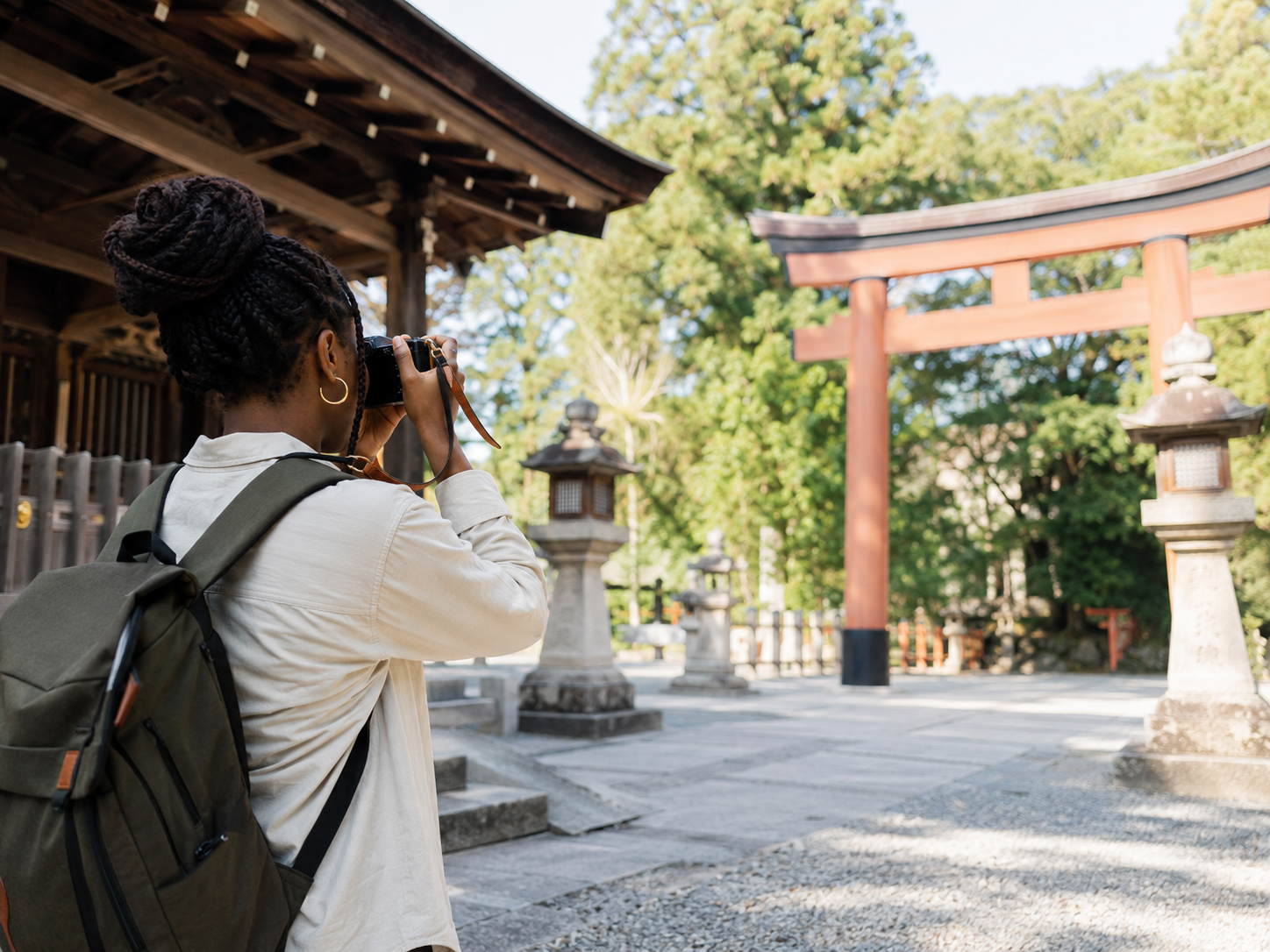
Can You Take Photos at a Shinto Shrine? Photography Etiquette in Japan
If you are visiting a Shinto shrine in Japan, you will probably want to take a few photos.
But you may also wonder:
Can you take photos at a Shinto shrine without being disrespectful?
In many shrine grounds, yes. Photography is often allowed.
Jinja Honcho, the Association of Shinto Shrines, explains that photography of shrine buildings and grounds is generally permitted, although it may be prohibited in certain places or situations. Visitors should follow the instructions of shrine staff.
Some shrines prohibit photography in particular worship areas. Others restrict tripods, selfie sticks, professional photography, livestreaming, or photos of shrine staff and sacred items.
The safest approach is simple:
- Check signs before taking a photo
- Follow the shrine’s own rules
- Avoid disturbing people who are praying
- Do not make strangers the subject of your photo without permission
- If you are unsure, ask
You do not need to be nervous about taking photos at a shrine. You just need to remember that you are visiting a place of worship as well as a place of cultural interest.
Is It Disrespectful to Take Photos at a Shinto Shrine?
Taking a photo at a Shinto shrine is not automatically disrespectful.
Photography is permitted in many shrine grounds.
The problem is usually not the act of taking a photograph itself. It is where, what, and how you photograph.
For example, a photo can become inappropriate if you:
- Ignore a “No Photography” sign
- Stand in front of people who are trying to pray
- Block a narrow shrine path for a long photo session
- Photograph an individual without permission
- Interrupt a ritual or ceremony
- Enter a restricted area to get a better shot
A Shinto shrine, or jinja, is a place where kami are enshrined and where people come to pray and participate in rituals.
If you are new to shrines, see What Is a Shinto Shrine? for a basic introduction.
You do not have to understand every aspect of Shinto before taking out your camera. Being aware of the people and rules around you is usually much more useful than worrying about an unwritten list of complicated taboos.
Where Can You Take Photos at a Shinto Shrine?
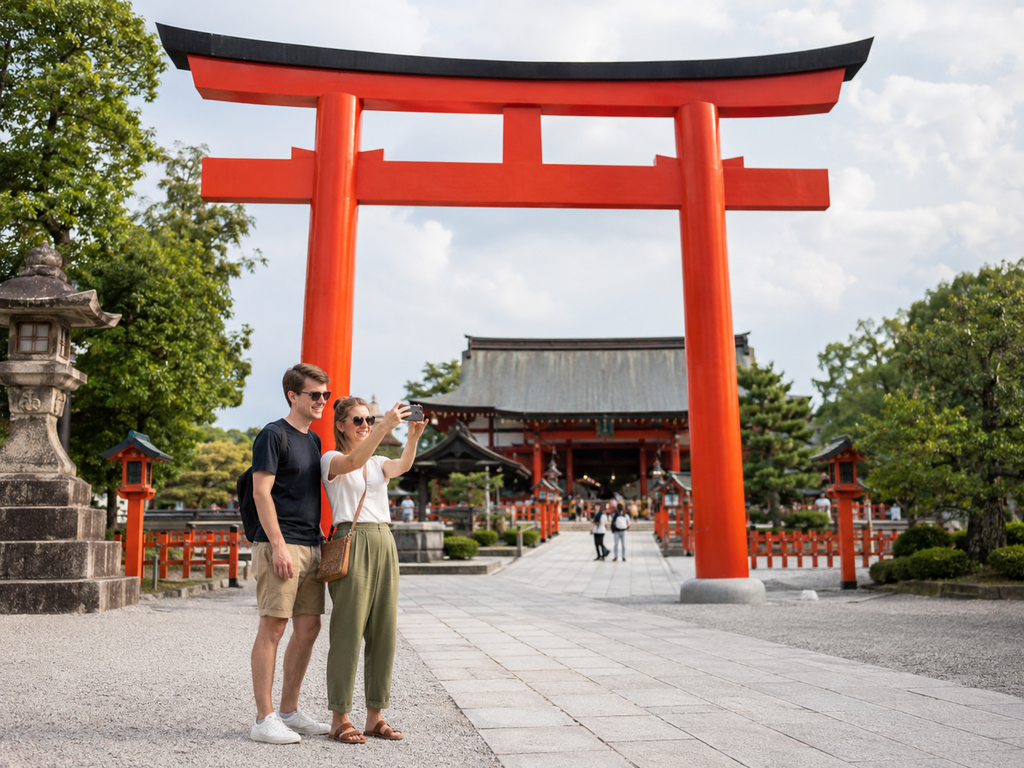
There is no nationwide list of places that are always safe to photograph.
A practical way to think about it is:
| Place | What to keep in mind |
|---|---|
| Torii gates | Often photographed, but do not block the entrance or path |
| Shrine paths and grounds | Often possible unless signs or staff say otherwise |
| Prayer area | Check carefully; some shrines prohibit photography here |
| Inside shrine buildings | Never assume photography or entry is permitted |
| Ceremonies and rituals | Rules vary; photography may be restricted |
| Amulet or goshuin counters | Check the individual shrine’s rules |
| Ema displays | Avoid close-up photos that reveal someone’s personal message |
Torii Gates and Shrine Grounds
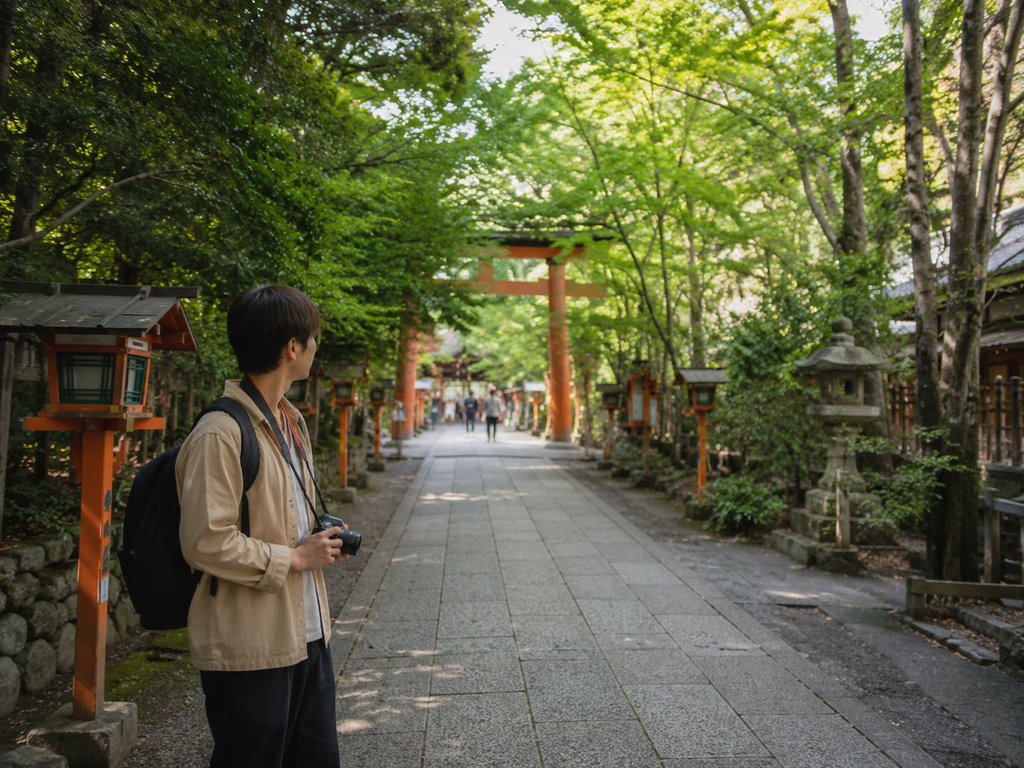
Torii gates are among the most photographed features of Shinto shrines.
There is generally no reason to assume that photographing a torii is prohibited simply because it is sacred architecture.
What matters is what is happening around you.
At a busy shrine, standing in the middle of an entrance for several minutes while taking repeated photos can prevent other visitors from entering or leaving.
Fushimi Inari Taisha in Kyoto, for example, specifically prohibits photography that prevents worshippers from passing along its narrow paths.
So rather than asking only:
“Can I photograph this torii?”
also ask:
“Am I getting in anyone’s way?”
For more about what a torii represents, see What Is a Torii Gate?
Prayer Areas and Main Shrine Buildings
This is where you should pay the most attention to signs.
Do not assume that every main shrine building is automatically a no-photo zone—but do not assume that photography is allowed either.
Rules can be very specific.
At Meiji Jingu in Tokyo, photography is permitted generally, but photos and videos are prohibited in front of the main shrine where people pray.
Other shrines draw the line differently.
If people are standing directly in front of the shrine to offer prayers, give them space even if photography itself is not prohibited.
If you want to understand what people are doing at the worship area, see How to Pray at a Japanese Shrine rather than trying to learn the prayer procedure from this photography guide.
Inside Shrine Buildings
Visitors normally worship from outside shrine buildings.
Do not enter a shrine building, fenced area, or other restricted space simply to take a photograph.
Even when an entrance appears open, entry may be limited to people participating in a prayer, ceremony, or other specific activity.
The same principle applies to photography: permission to be somewhere does not automatically mean permission to photograph everything there.
Look for signs and follow staff instructions.
Can You Photograph Other People at a Shrine?
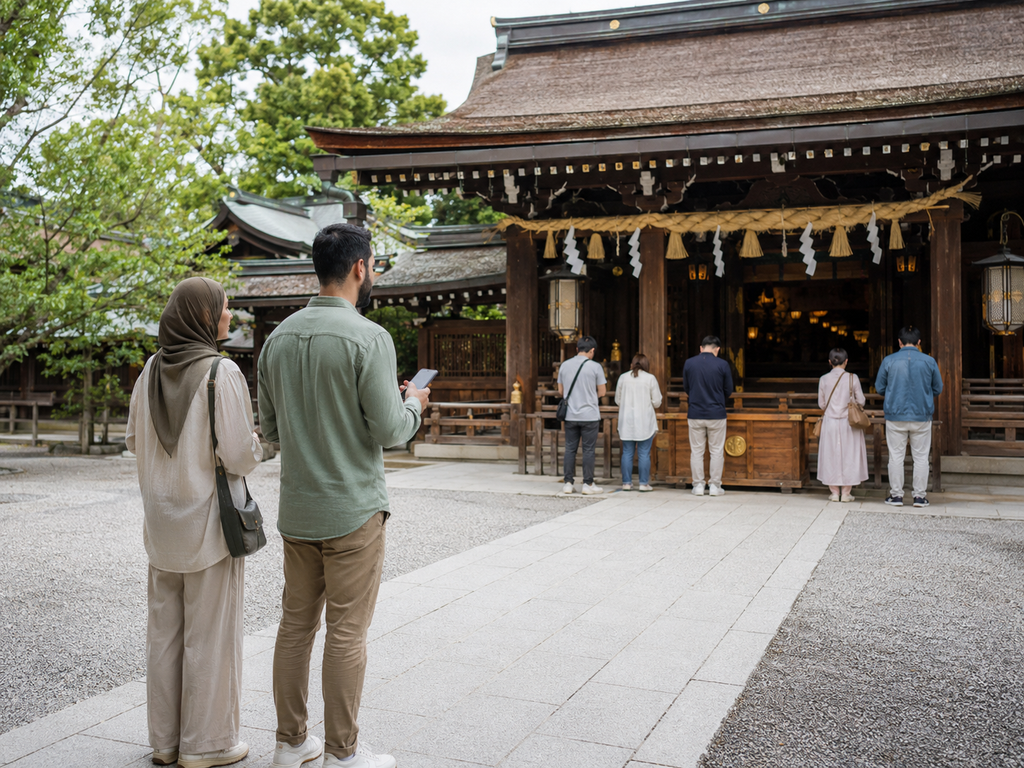
Be careful when other visitors become the subject of your photograph.
Japan’s National Tourism Organization(JNTO) recommends asking permission before deliberately photographing individuals, and Jinja Honcho also advises visitors not to photograph people without their permission.
There is a difference between:
- A person appearing incidentally in a wide photo of a crowded shrine
- Deliberately taking a close or identifiable photograph of someone praying
The second deserves much more caution.
People may be visiting for personal prayers, family occasions, memorial observances, or important life events.
Give people space, particularly around the main prayer area.
The same applies to children. Do not make a child the subject of your photograph without permission from the accompanying adult.
Can You Photograph Miko or Shinto Priests?
Do not assume that shrine staff are available as photo subjects simply because their clothing is interesting to visitors.
Miko are shrine attendants, while Shinto priests perform rituals and other duties at the shrine.
Some shrines explicitly restrict photographing them.
For example, Kasugataisha in Nara prohibits unauthorized photography of shrine staff including Shinto priests and miko. Yasaka Shrine in Kyoto also prohibits photographing priests, miko, and other worshippers without permission.
These are individual shrine policies rather than a nationwide rule.
Still, they provide a useful general principle:
If you want to make a shrine staff member the subject of your photo, ask first rather than assuming.
What About Shinto Weddings, Rituals, and Ceremonies?
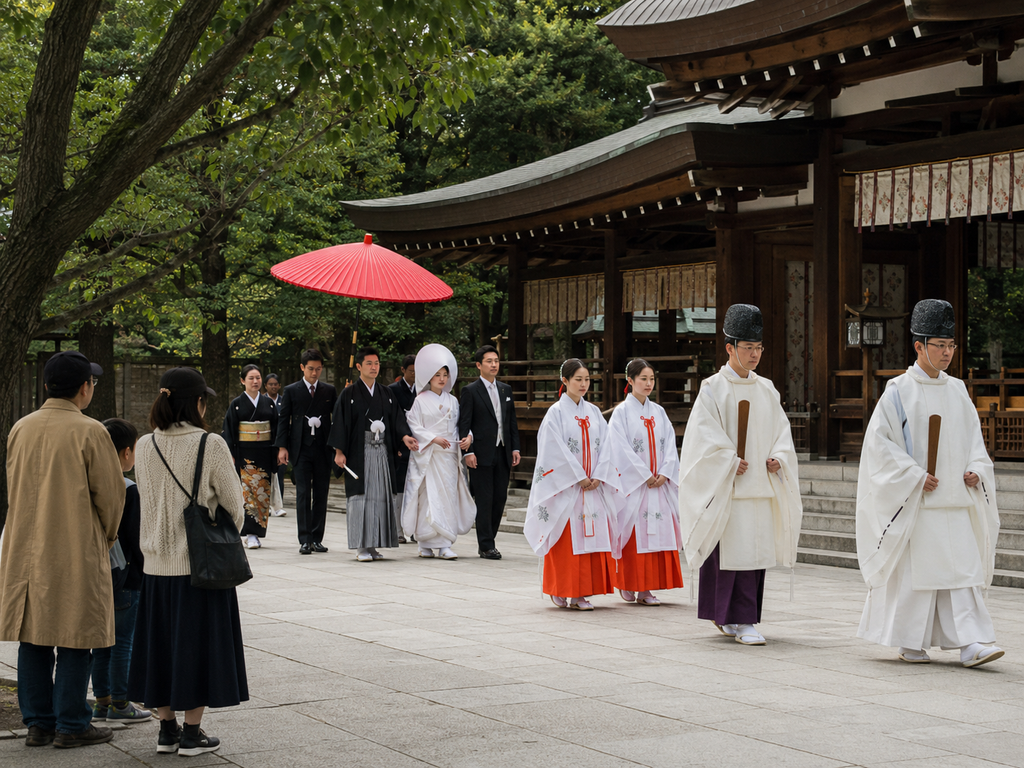
Seeing a Shinto wedding or ceremony can be memorable, especially if you were not expecting to encounter one.
But do not assume that an event taking place where visitors can see it is automatically open for photography.
Rules vary considerably.
At Meiji Jingu, photography is prohibited during its kigansai, a formal prayer ceremony.
Kasugataisha has its own detailed photography rules for weddings, including restrictions on who may take photographs during the ceremony.
The practical rule for travelers is straightforward:
- Do not interrupt a procession or ceremony
- Stay outside barriers and restricted areas
- Do not move closer just to get a photograph
- Follow staff instructions
- Be especially careful when photographing identifiable participants
If photography is important to you because you are actually participating in a wedding, prayer, or family ceremony, check directly with that shrine in advance.
Can You Photograph Omamori, Goshuin, and Amulet Offices?
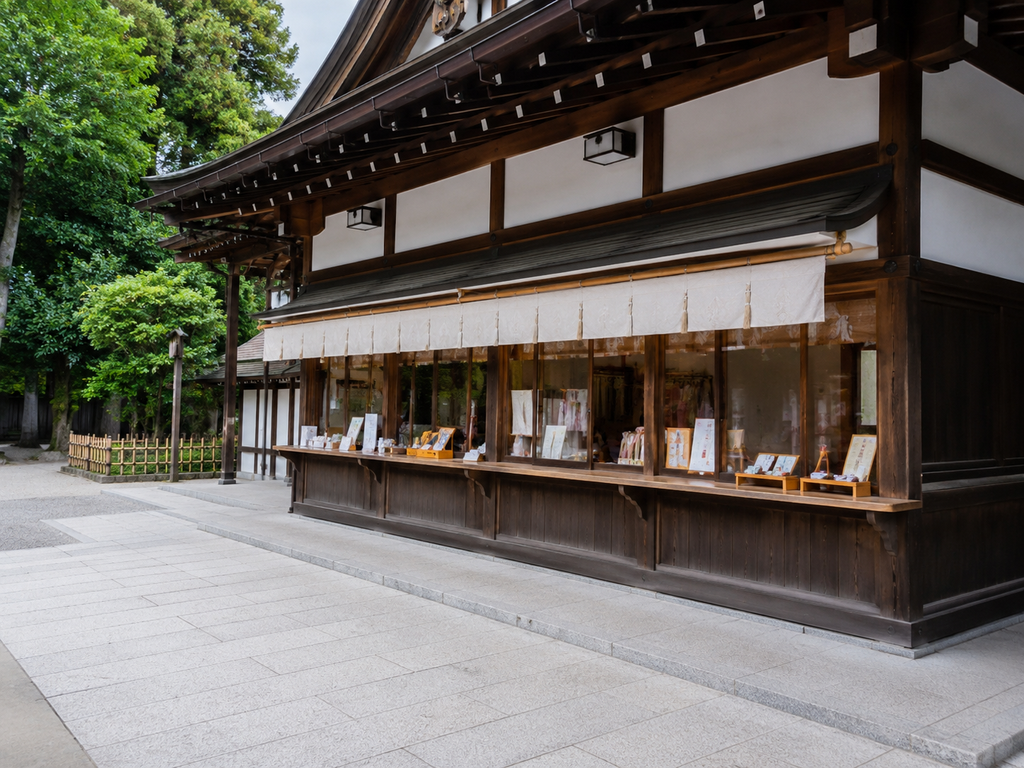
Again, rules vary.
An omamori is a protective amulet offered at shrines and temples, while a goshuin is a seal and calligraphy received as a record of a visit to a shrine or temple.
You may see beautiful amulets, displays, or counters and naturally want to photograph them.
But some shrines have specific restrictions.
Meiji Jingu asks visitors to refrain from photographing its amulet office. Yasaka Shrine lists photography of items being offered at the shrine among its prohibited activities.
That does not mean every shrine in Japan bans photographs of omamori or goshuin.
It means you should check before photographing the counter, staff, or displayed items.
For the objects themselves, see What Is an Omamori? and What Is a Goshuin?
Be Careful When Photographing Ema
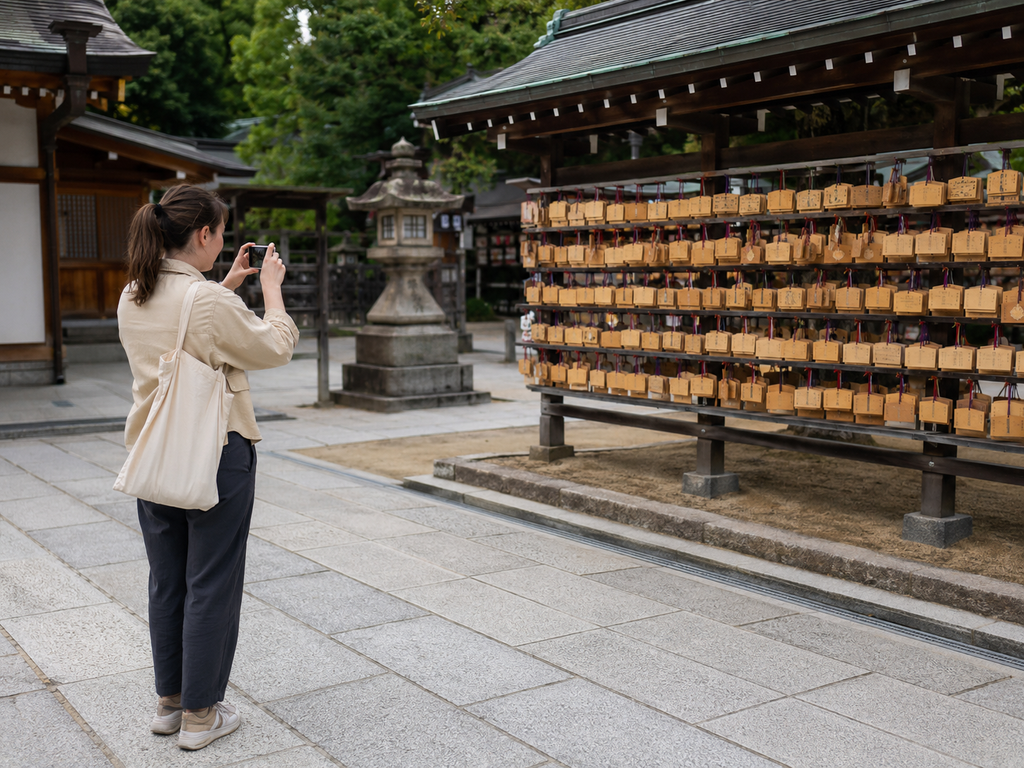
Ema are wooden votive plaques on which visitors write wishes or messages.
They are often displayed together on racks and can be visually interesting.
However, those messages may contain personal information or private thoughts.
Kasugataisha specifically asks people posting personal photographs on social media to consider the personal information written on ema.
A wide photo of an ema display is different from taking a close-up photograph designed to make another person’s message readable.
A useful rule is:
Do not turn someone else’s prayer or wish into your content.
For more about the plaques themselves, see What Is an Ema?
Are Smartphones and Professional Cameras Treated Differently?
There is no general Shinto rule that says:
Smartphone = allowed
DSLR or mirrorless camera = prohibited
The device itself is often not the most important question.
Instead, shrine policies may distinguish between:
- Casual personal photography
- Long photo sessions
- Tripods or lighting equipment
- Selfie sticks
- Professional photographers
- Commercial photography
- Livestreaming
- Drones
For example, Ise Jingu prohibits photography in designated no-photo areas as well as long sessions using tripods, stepladders, drones, livestreaming, and commercial photography including certain monetized uses.
Dazaifu Tenmangu similarly allows ordinary personal snapshots without strict regulation while restricting photography inside the main sanctuary, prolonged tripod use, drones, livestreaming, and commercial use.
Yasaka Shrine prohibits equipment including tripods, stepladders, and selfie sticks.
So carrying a large camera does not automatically mean you are doing something wrong.
What matters more is how you are using it and whether the shrine permits that kind of photography.
What About Flash?
If a shrine displays a no-flash sign, follow it.
Even where flash is not specifically mentioned, turning it off around people who are praying or during a quiet ceremony is a simple way to avoid unnecessary disruption.
Real Shrines Have Different Photography Rules
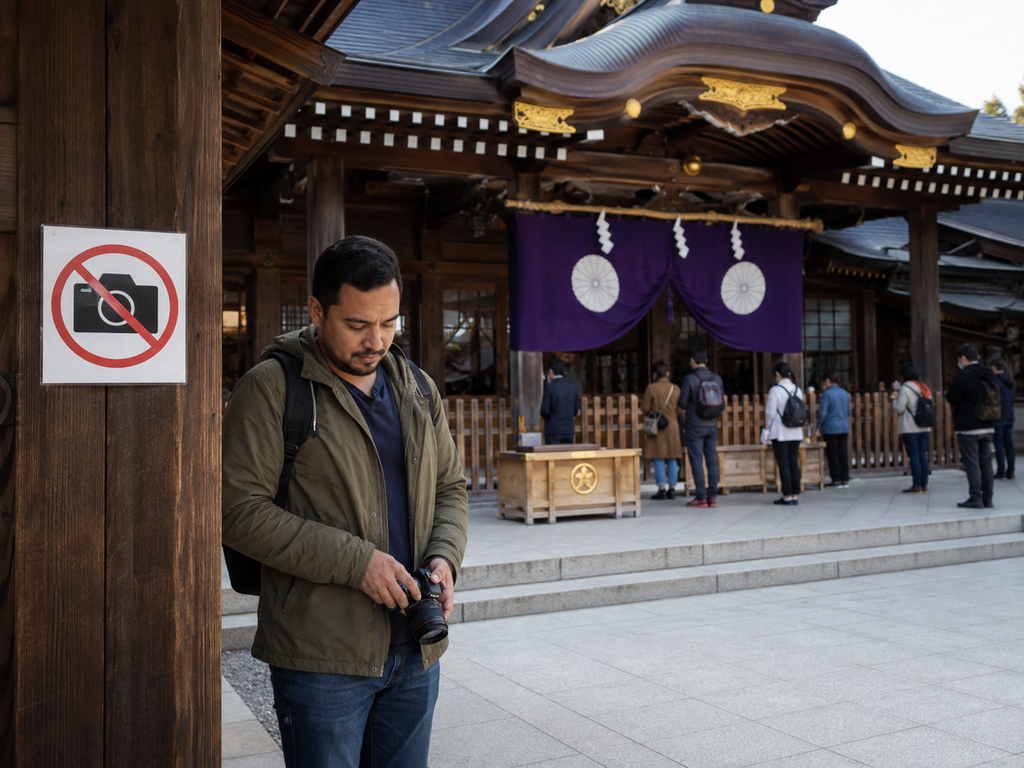
Looking at actual shrine policies makes one thing clear: there is no universal photography rule for every Shinto shrine.
| Shrine | Example of its photography policy |
|---|---|
| Meiji Jingu | Photography generally allowed, but prohibited in front of the main shrine where people pray; visitors are also asked not to photograph the amulet office |
| Fushimi Inari Taisha | Prohibits commercial photography, photography in prohibited areas, and photography that blocks narrow paths |
| Ise Jingu | Restricts no-photo areas, prolonged tripod use, stepladders, drones, livestreaming, and commercial photography |
| Dazaifu Tenmangu | Personal snapshots are not strictly restricted, but the shrine prohibits photography inside the main sanctuary and several types of equipment or commercial use |
| Yasaka Shrine | Allows personal snapshots in general but lists numerous restrictions including photography inside the honden, shrine items, unauthorized photos of staff and worshippers, and certain equipment |
| Kasugataisha | Restricts photography that interferes with rituals or visitors and has specific policies covering shrine staff, weddings, equipment, commercial work, and personal information |
These examples should not be memorized as rules for all shrines.
They show why checking the shrine you are actually visiting matters.
Can You Post Shrine Photos on Social Media?
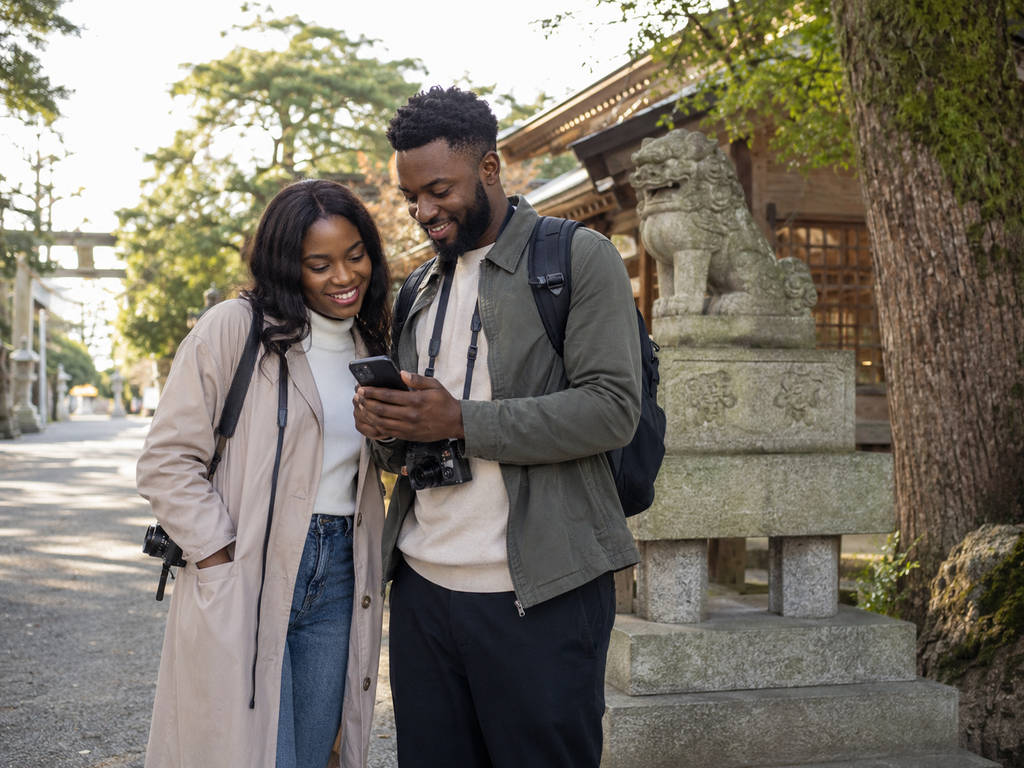
Usually, a casual travel photo and a commercial production are not treated in exactly the same way.
But you still need to think about what your photo contains.
Before posting, check whether the image clearly shows:
- Someone praying
- A child or other identifiable visitor
- A private ceremony
- A readable ema containing someone’s personal message
- Shrine staff who did not agree to be photographed
- An area where photography itself was prohibited
Also remember that some shrines distinguish personal photography from commercial or monetized use.
Ise Jingu and Dazaifu Tenmangu, for example, explicitly include certain monetized publication within their rules on commercial photography.
If your photos or videos are being produced for a business, advertising campaign, monetized media project, or professional assignment, check the shrine’s policy rather than assuming personal-travel rules apply.
What Should You Do If You Are Not Sure?
You do not need to guess.
Use this order:
1. Look for signs
A crossed-out camera icon is the clearest warning, but there may also be written instructions near the entrance, worship area, or counter.
2. Look at the area
Is it a normal open part of the grounds, or are you approaching a prayer area, building interior, ceremony, or restricted space?
3. Look at the people around you
Would taking the photo disturb someone who is praying or block people trying to move through the shrine?
4. Ask
If staff are available, you can ask:
Koko wa shashin o totte mo ii desu ka?
“Is it okay to take photos here?”
You do not need perfect Japanese. Pointing gently toward your camera while asking is usually enough to make the question clear.
5. If you are still unsure, skip the photo
Missing one photograph is better than interrupting someone’s prayer or ignoring a rule you did not understand.
Take Photos, but Follow the Shrine’s Rules
So, can you take photos at a Shinto shrine?
In many cases, yes.
You do not need to put your camera away the moment you pass through a torii gate.
But there is also no nationwide rule saying that everything inside a shrine is free to photograph.
Check the signs.
Give worshippers space.
Do not photograph individuals without permission.
Respect ceremonies and restricted areas.
And follow the rules of the shrine you are actually visiting.
That is usually all you need to enjoy taking photos without turning shrine etiquette into something intimidating.
Shrine Etiquette Guide
Photography is only one part of shrine etiquette.
Knowing when to take photos is helpful, but shrine etiquette also includes how to pass through a torii gate, how to use the temizuya, how to pray, and how to behave around goshuin, omamori, and sacred spaces.
Jin-journey’s English shrine etiquette PDF gives first-time visitors a simple visual guide to the basics, so you can check the flow on your phone while traveling in Japan.
See the Japanese Shrine Etiquette Guide on EtsyContinue Your Journey
Knowing when to take a photo is just one part of visiting a Shinto shrine respectfully.
These guides will help you understand what to do as you make your way through the shrine: