
Omikuji Translation Guide: What Do the Japanese Words Mean?
You have just drawn an omikuji at a shrine or temple in Japan.
You unfold the paper and see 大吉 (Daikichi). Great! You have received a very favorable fortune.
But then you notice all the other Japanese writing.
願望. 待人. 失物. 縁談.
What do these characters mean? And what are the short sentences beside them trying to tell you?
This omikuji translation guide will help you identify common Japanese words, understand their English meanings, and read the advice written on your fortune slip.
You don’t need to know Japanese to get started. Compare the Japanese characters in this guide with the ones printed on your own omikuji.
We’ll also use real examples from omikuji collected at Japanese shrines, including Namba Shrine in Osaka, Fushimi Inari Taisha in Kyoto, and Meiji Jingu in Tokyo.
If you want to learn what omikuji are, how to draw one, or how fortune rankings work, start with our complete guide to Japanese omikuji.
How to Find the Words on Your Omikuji
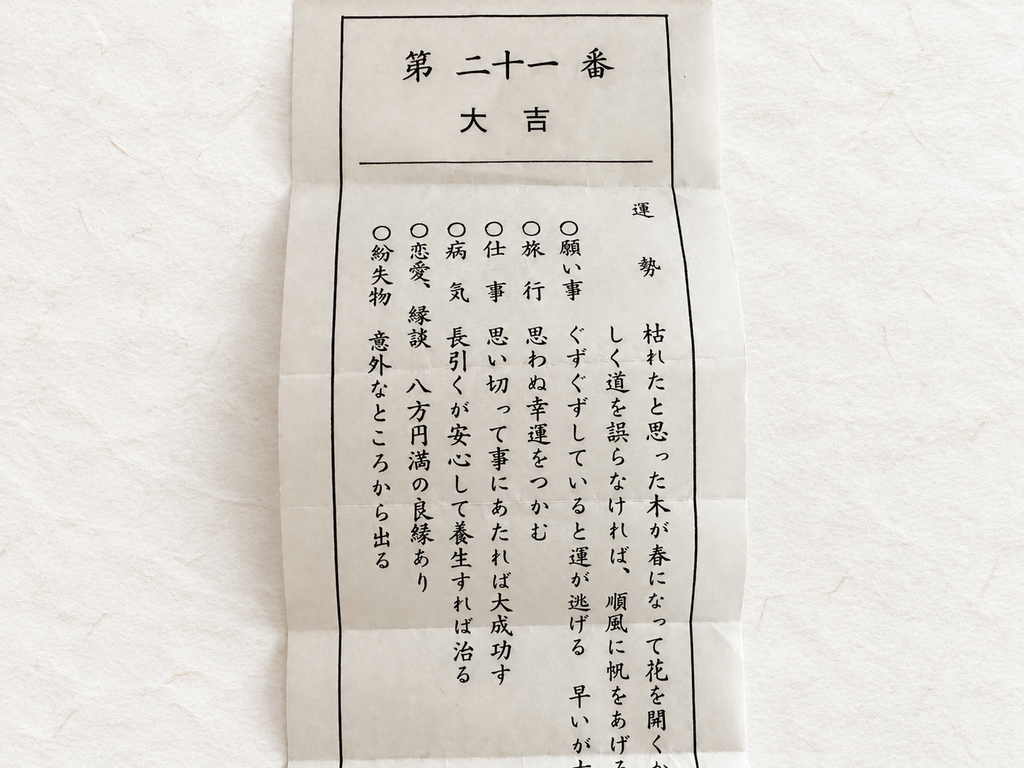
Before translating anything, take a look at how your omikuji is arranged.
Many traditional fortune slips are printed vertically, with Japanese characters running from top to bottom.
In vertical Japanese writing, columns are generally read from right to left.
Depending on the omikuji, you may find three main elements.
1. Your Overall Fortune
Look for large characters such as:
大吉 — Great fortune
吉 — Good fortune
小吉 — A modestly favorable fortune
凶 — Bad fortune
These tell you the general fortune category, although the ranking system varies by shrine and temple.
2. Headings About Different Areas of Life
These are often short Japanese labels such as:
願望 — Wishes
待人 — Someone you are waiting for
旅行 — Travel
恋愛 — Romantic relationships
The headings tell you which part of your life the advice concerns.
3. Short Messages Beside the Headings
These are the parts that can be surprisingly difficult to translate.
A message might say that something will happen, that you should wait, or that a particular action is favorable.
The heading gives you the context you need to understand the sentence.
Not all omikuji have the same layout, and some use completely different formats.
Common Omikuji Words: Japanese-to-English Translation
Use this section as a visual reference.
Find the Japanese characters that match your fortune slip, then read the English explanation underneath.
You do not need to pronounce the Japanese words. The romanized readings are included only as a reference.
Wishes and Personal Goals
願望 / 願事 / 願い事
ganbō / negaigoto
English meaning: Wishes / Things you hope to achieve
This heading refers to something you want to happen or accomplish.
The message beside it may indicate whether the wish is likely to be fulfilled, whether it will take time, or whether you should change your approach.
The heading itself does not tell you whether your wish will come true.
Someone You Are Waiting For
待人 / 待ち人 / まち人
machibito
English meaning: An awaited person / Someone you are waiting for
This is one of the easiest omikuji terms to misunderstand.
It does not automatically mean your soulmate, future partner, or someone you will marry.
It refers to a person whose arrival or contact is awaited. The surrounding wording may give more detail.
Lost Items
失物 / 失せ物 / 紛失物
usemono / funshitsubutsu
English meaning: Lost items / Something you have lost
This section concerns a missing possession.
The message might indicate that the item will be found, that it will be difficult to recover, or that you should look in a particular direction or place.
Travel
旅行 / 旅立ち / たびだち
ryokō / tabidachi
English meaning: Travel / Setting out on a journey
This section concerns travel and journeys.
The message may indicate whether travel is favorable or whether caution is advised.
Business and Commerce
商売 / あきない
shōbai / akinai
English meaning: Business / Trade / Commerce
This heading concerns commercial activity.
Depending on the wording, the message might discuss buying, selling, profits, or whether a business decision is favorable.
Studies and Education
学問 / 学業
gakumon / gakugyō
English meaning: Study / Education / Academic progress
This section concerns learning and academic pursuits.
Some messages emphasize effort and preparation rather than simply predicting success.
Romantic Relationships
恋愛
ren’ai
English meaning: Love / Romantic relationships
This section concerns romance.
It is not necessarily a prediction about marriage.
Marriage Prospects
縁談
endan
English meaning: Marriage prospects / Marriage arrangements
縁談 traditionally refers to discussions or arrangements connected with a possible marriage, including matchmaking.
It is not exactly the same as 恋愛 (romance).
An omikuji may contain separate advice for both categories.
Illness and Health
病気
byōki
English meaning: Illness / Health concerns
This section concerns illness or recovery.
Traditional fortune wording may describe whether recovery is expected or advise patience and care.
It should not be treated as medical advice or a diagnosis.
Moving Home
転居 / 転宅 / 家うつり
tenkyo / tentaku / ieutsuri
English meaning: Moving house / Changing your place of residence
This section concerns relocation.
The message may describe whether moving is favorable or whether waiting would be better.
Disputes and Conflicts
争事 / 争い事
arasoigoto
English meaning: Disputes / Conflicts
This section concerns disagreements, arguments, or disputes.
The message might advise caution, patience, or avoiding unnecessary confrontation.
Employment
就職
shūshoku
English meaning: Finding a job / Employment
This heading concerns job seeking or employment.
Direction
方角 / 方がく
hōgaku
English meaning: Direction / Favorable direction
Some omikuji give advice connected with a particular direction.
Read the full sentence rather than assuming a direction is always favorable.
Financial and Market Matters
金運
kin’un
English meaning: Money luck / Financial fortune
相場
sōba
English meaning: Market conditions / Trading
These are different categories. 金運 refers broadly to financial fortune, while 相場 relates more specifically to market or trading conditions.
Buying, Selling, and Competition
売買
baibai
English meaning: Buying and selling
勝負
shōbu
English meaning: Competition / Contest / Outcome of a challenge
These headings may appear on more traditional omikuji.
As with the other categories, their meaning depends on the advice that follows.
How to Translate the Short Phrases on an Omikuji
Knowing the headings is only the first step.
Now let’s look at the actual sentences.
The examples below come from real omikuji obtained during visits to Japanese shrines and photographed for Jin-Journey.
For each example, we’ll show the original Japanese, a natural English translation, and the meaning that might not be obvious from a word-for-word translation.
The English translations are provided by Jin-Journey unless otherwise stated. They are not official translations issued by the shrines.
Example 1: Someone Will Come with Good News
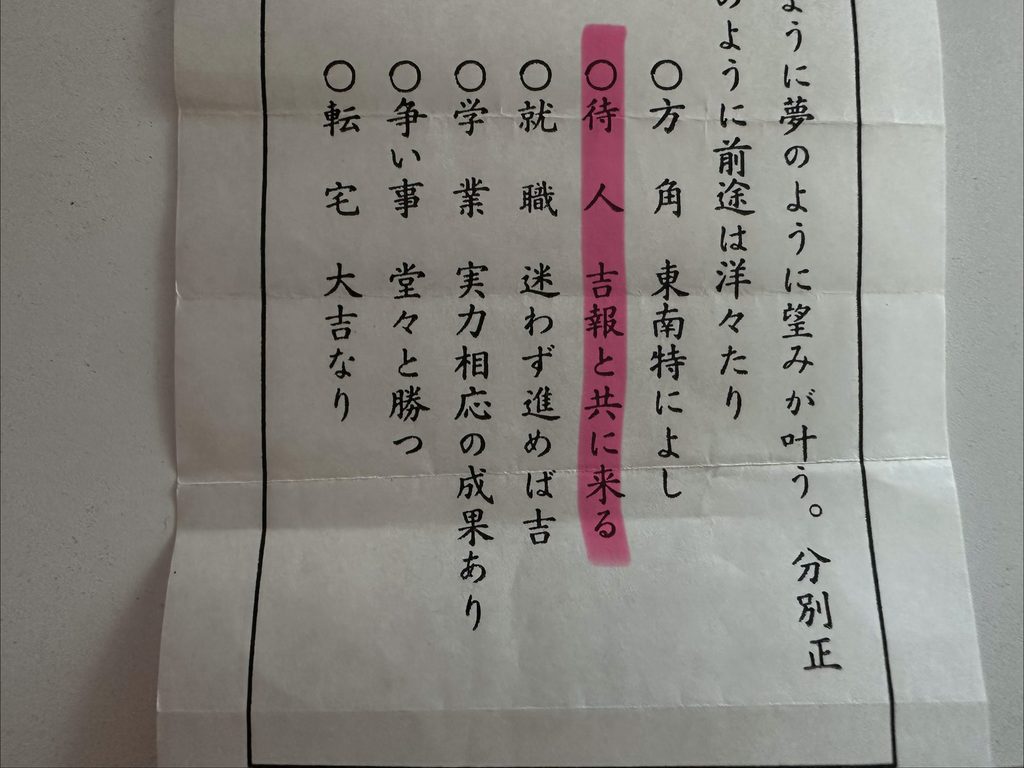
待人
machibito — Someone you are waiting for
ORIGINAL JAPANESE
吉報と共に来る
NATURAL ENGLISH TRANSLATION
“Someone you are waiting for will arrive with good news.”
WHAT THE JAPANESE MEANS
吉報 (kippō) means good news.
共に (tomo ni) means together with.
来る (kuru) means to come.
So the message describes the arrival of an awaited person together with favorable news.
It is a positive message, but it does not specify a romantic partner.
Real example: Namba Shrine, Osaka.
Example 2: Don’t Delay Too Long
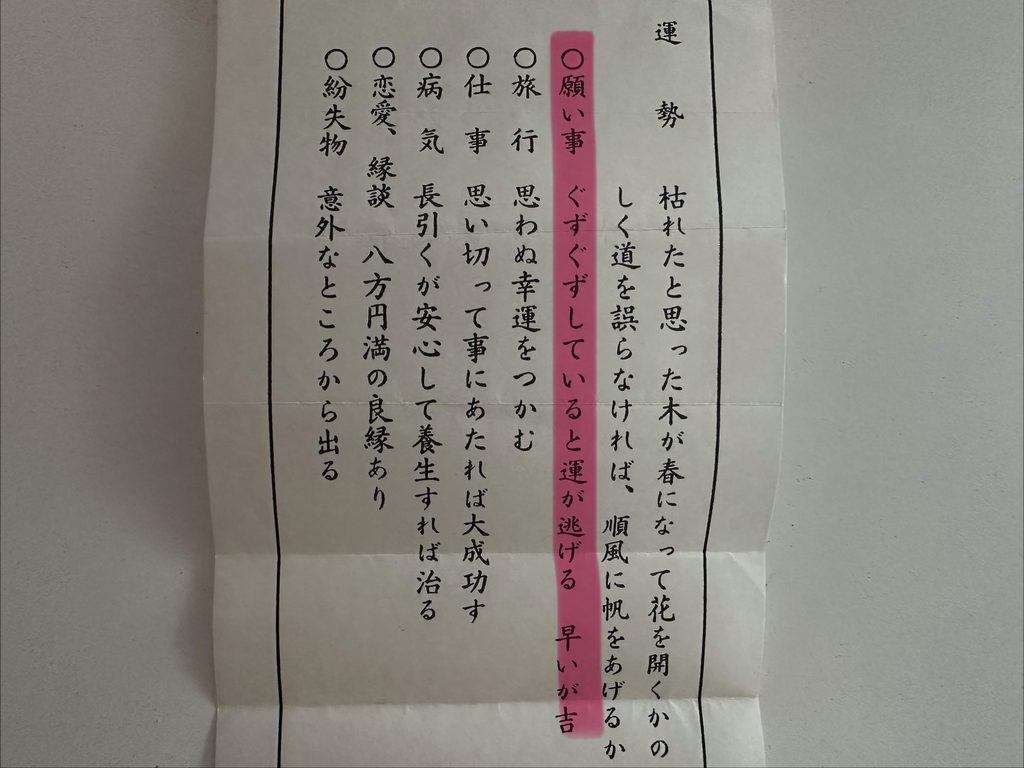
願い事
negaigoto — Wishes
ORIGINAL JAPANESE
ぐずぐずしていると運が逃げる 早いが吉
NATURAL ENGLISH TRANSLATION
“If you keep hesitating or putting things off, your luck may slip away. Acting sooner is favorable.”
WHAT THE JAPANESE MEANS
ぐずぐずしている describes hesitating, delaying, or failing to act promptly.
運が逃げる literally means “luck escapes.”
And 早いが吉 means that doing something sooner is the favorable choice.
The phrase uses a vivid expression rather than simply saying “act quickly.”
It also shows why even a Daikichi fortune can contain practical advice.
Receiving a favorable fortune does not mean you should do nothing and wait for good things to happen.
Real example: Namba Shrine, Osaka.
Example 3: Your Lost Item May Turn Up Unexpectedly
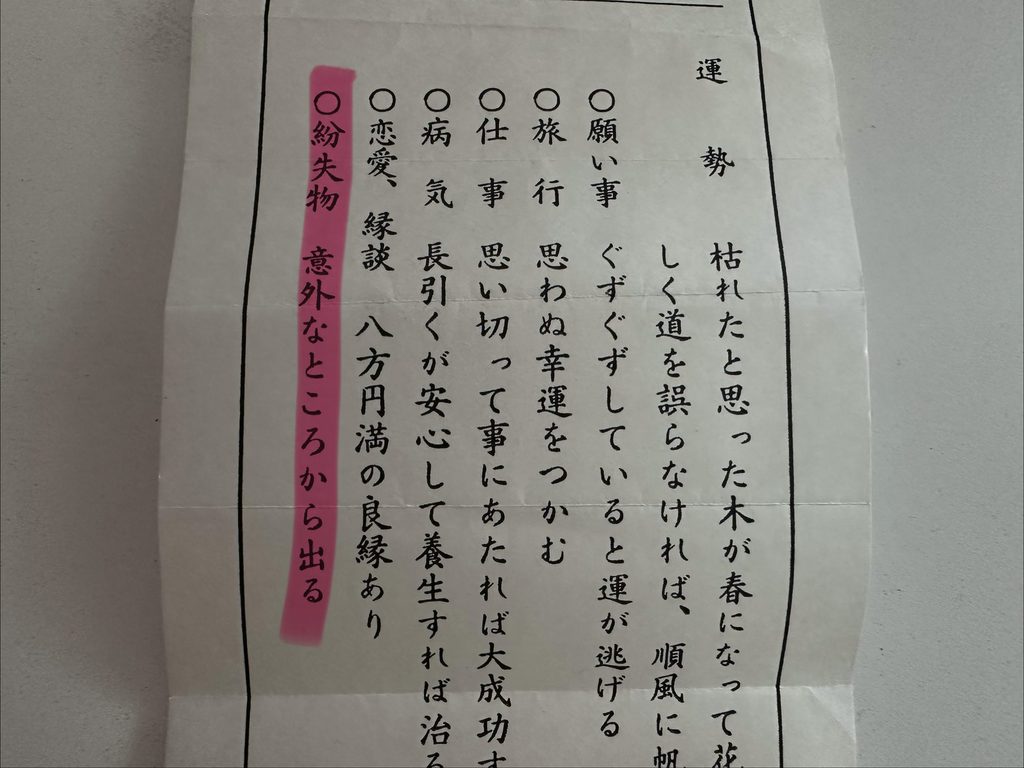
紛失物
funshitsubutsu — Lost items
ORIGINAL JAPANESE
意外なところから出る
NATURAL ENGLISH TRANSLATION
“The lost item will turn up somewhere unexpected.”
WHAT THE JAPANESE MEANS
意外なところ (igai na tokoro) means an unexpected place.
出る (deru) commonly means “to come out” or “to appear.”
Here, it describes a lost possession turning up or being found.
Translating 出る simply as “come out” would sound unnatural without the context provided by 紛失物.
Real example: Namba Shrine, Osaka.
Real Omikuji Example: Namba Shrine in Osaka
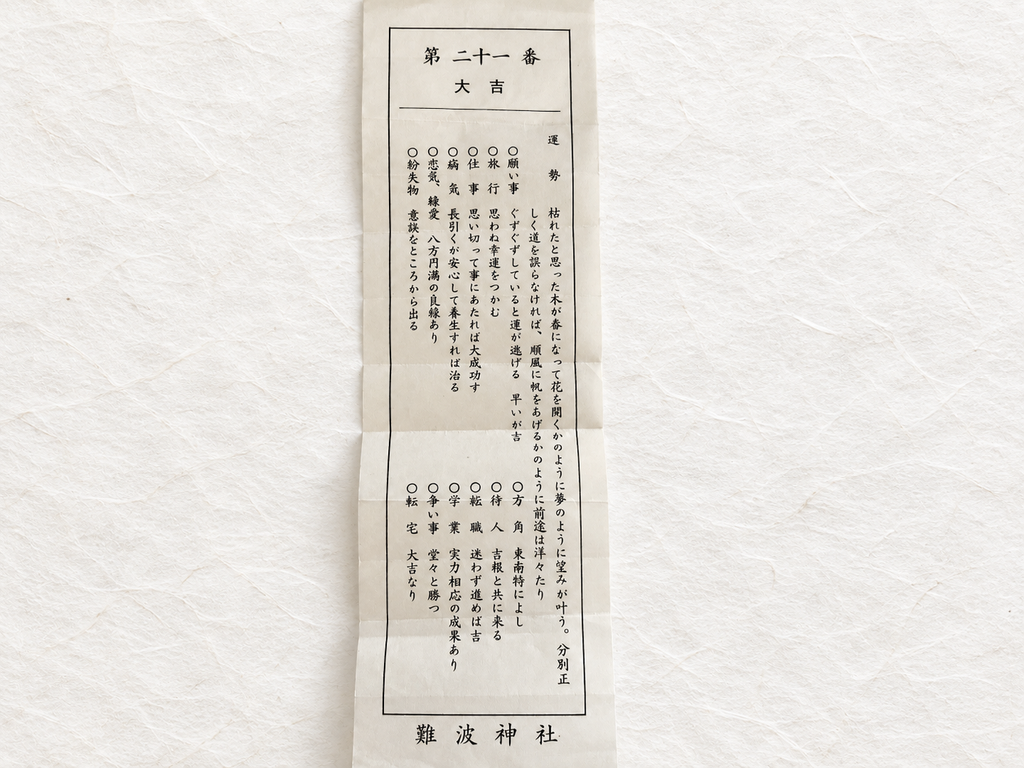
Now that you’ve seen how individual phrases work, let’s look at the fortune slip as a whole.
One of the omikuji collected for this article comes from Namba Shrine in Osaka.
At the top, it reads:
第二十一番
Number 21
大吉
Daikichi — Great fortune
Below the main fortune, it includes several short messages about different areas of life.
Here are some selected headings from that actual slip:
| Japanese to Match | Meaning in English |
|---|---|
| 願事 | Wishes |
| 旅行 | Travel |
| 仕事 | Work |
| 病気 | Illness or health |
| 恋愛・縁談 | Romance and marriage prospects |
| 紛失物 | Lost items |
| 方角 | Direction |
| 待人 | Someone you are waiting for |
| 就職 | Employment |
| 学業 | Studies |
| 争い事 | Disputes |
| 転宅 | Moving home |
The fortune gives an overall result of Daikichi, but it also contains specific advice for each category.
For example:
待人 — 吉報と共に来る
“Someone you are waiting for will come with good news.”
紛失物 — 意外なところから出る
“A lost item will turn up somewhere unexpected.”
The messages are short, but they do not all say the same thing.
Some describe a possible outcome, while others recommend an action.
When reading your own omikuji, try to distinguish between the heading and the sentence that follows it.
That simple step makes a surprisingly big difference when translating Japanese fortune slips.
Why the Same Omikuji Word May Look Different at Another Shrine
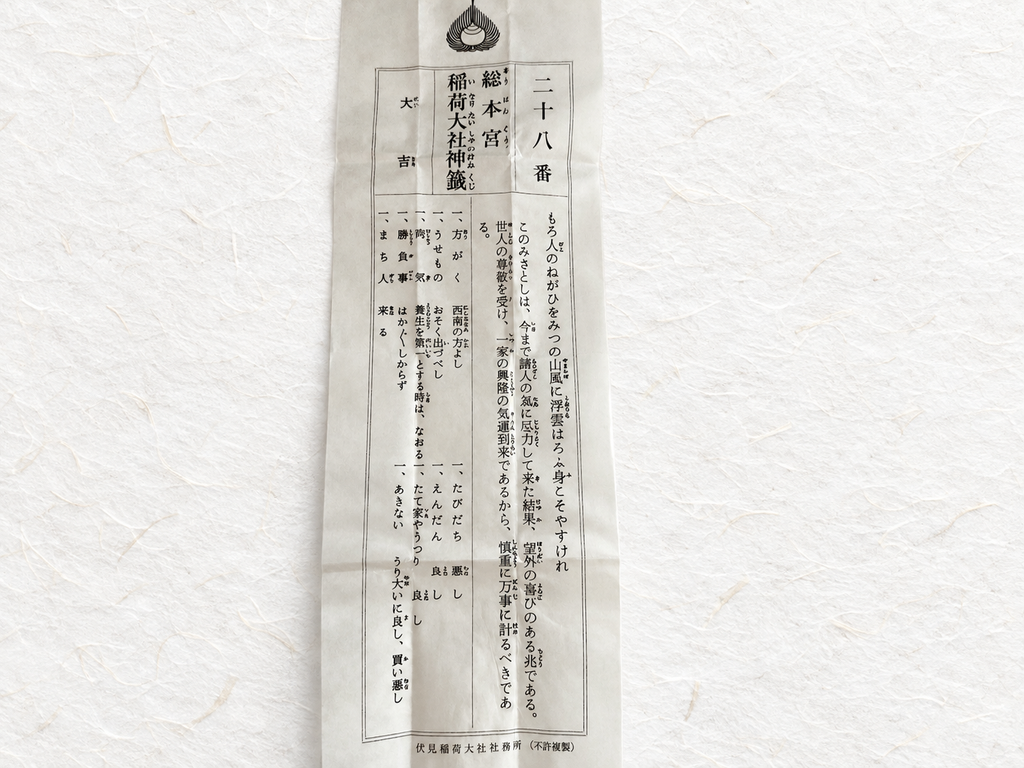
Japanese omikuji do not all use identical vocabulary or spelling.
Compare the omikuji from Namba Shrine with another collected at Fushimi Inari Taisha in Kyoto.
The Namba Shrine slip uses:
待人
machibito — Someone you are waiting for
The Fushimi Inari Taisha slip uses:
まち人
machibito — Someone you are waiting for
These are two ways of writing the same heading.
The second version combines hiragana (まち) with kanji (人).
The meaning of the heading is the same, although the fortune messages that follow it are not necessarily identical.
Similarly, the Fushimi Inari Taisha slip contains the following headings:
あきない
akinai — Business or trade
たびだち
tabidachi — Setting out on a journey
えんだん
endan — Marriage prospects
うせもの
usemono — Lost items
If you cannot find a heading from the translation list on your own slip, look for a similar word written in hiragana or with different characters.
But do not assume that every similar-looking phrase has exactly the same meaning. The surrounding sentence still matters.
Japanese Expressions That Are Easy to Misunderstand
Does 待人 Mean Your Soulmate?
No—not automatically.
待人
machibito — Someone you are waiting for
An English translation that says “your soulmate is coming” may sound exciting, but it adds a romantic meaning that is not necessarily present.
This is especially important when the same omikuji also has separate categories for romance and marriage.
Are 恋愛 and 縁談 the Same?
No.
恋愛
ren’ai — Romantic relationships
縁談
endan — Marriage prospects or marriage arrangements
An omikuji may address them together or separately.
Translating both simply as “love” can make the distinction disappear.
Does 吉 Always Mean Your Fortune Ranking?
No.
You may recognize:
吉
kichi — Good fortune
as one of the favorable fortune categories.
However, 吉 can also appear within short sentences.
For example:
早いが吉
“Acting sooner is favorable.”
Here, 吉 describes a favorable course of action.
It is not a separate ranking for the entire fortune slip.
Why Does 来る Sometimes Mean More Than “Come”?
来る
kuru — To come
The word itself is straightforward.
However, the English sentence may need more context to sound natural.
For example:
待人 吉報と共に来る
Rather than translating it word for word as “Waiting person comes with good report,” a more natural version is:
“Someone you are waiting for will arrive with good news.”
The Japanese heading supplies the context, while the sentence supplies the additional information.
This is one reason automated translations of omikuji can sometimes sound strange.
Not All Omikuji Have Daikichi or Kyo: Meiji Jingu’s Omigokoro
Some omikuji are very different from the typical fortune slip.
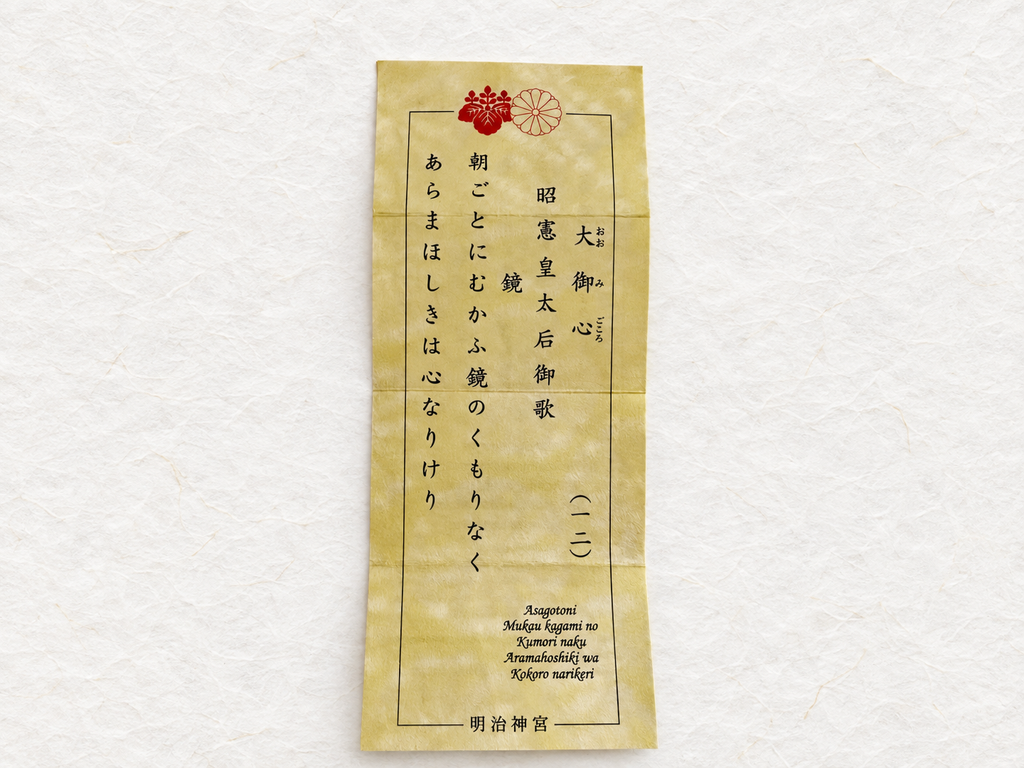
A good example is the Omigokoro (大御心) offered at Meiji Jingu in Tokyo.
Unlike many familiar omikuji, Omigokoro does not give a fortune ranking such as Daikichi or Kyo.
Instead, it presents a waka poem composed by Emperor Meiji or Empress Shoken, together with explanatory text.
The example collected for this article contains a poem by Empress Shoken that begins:
朝ごとにむかふ鏡の
Asagoto ni mukau kagami no…
Its imagery concerns looking into a mirror each morning, with the accompanying explanation encouraging reflection on one’s own heart and conduct.
The printed slip also includes an English rendering and an explanation.
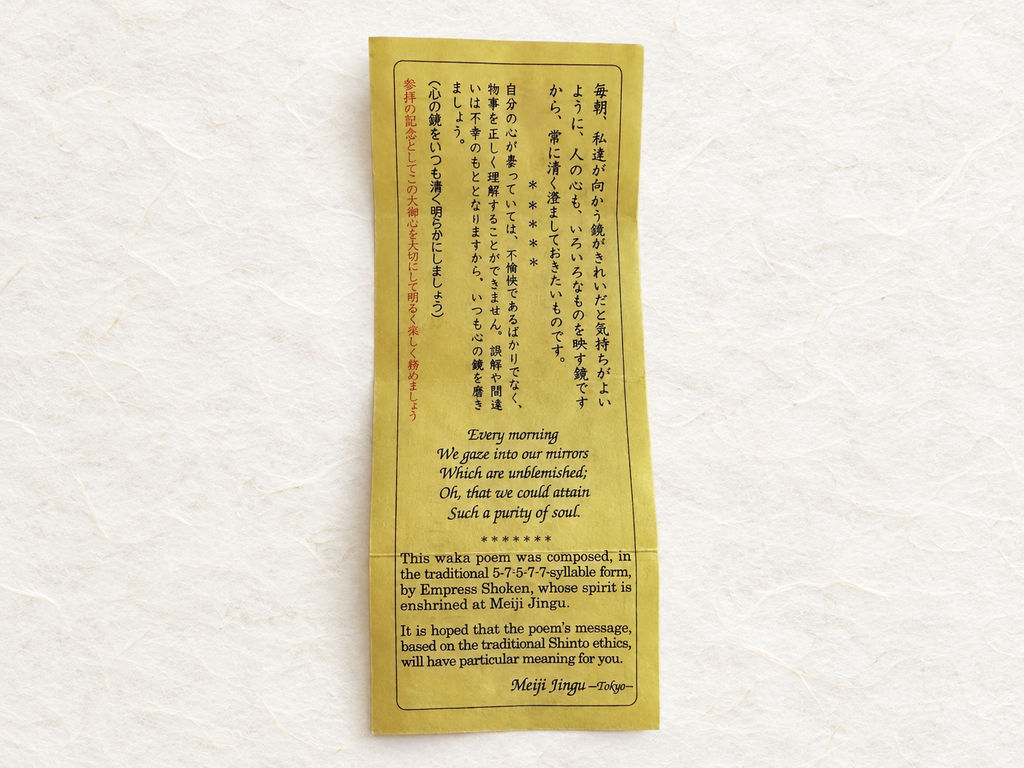
There is no need to look for headings such as 待人 or 失物 on this type of omikuji.
It is intended to be read differently.
Meiji Jingu’s official explanation of Omigokoro confirms that it is a distinctive form of omikuji without the usual fortune rankings.
The important lesson is that there is no single translation chart that works for every omikuji in Japan.
First, identify what type of fortune slip you have.
What If Your Omikuji Says 小吉 or 凶?
You may receive a different fortune ranking from the ones shown in our real examples.
Here are two common terms.
小吉
shokichi
English meaning: A modestly favorable fortune
This is a favorable category in many ranking systems, although its exact position can vary.
凶
kyō
English meaning: Bad fortune / Unfavorable fortune
This is an unfavorable result, but it should not be read as a guarantee that something terrible will happen.
The Japan Shrine Association explains that omikuji should not be understood only through their good-or-bad rankings. Their messages can also serve as guidance for everyday life.
At Senso-ji Temple in Tokyo, the official explanation encourages those who receive Kyo not to fear the result and to value careful, sincere conduct.
Even when your ranking is less favorable than you hoped, read the individual messages before deciding what they mean.
For a more detailed explanation of Daikichi, Kichi, Chukichi, Shokichi, and other fortune categories, visit our guide to omikuji meanings and rankings.
Can Google Translate Read a Japanese Omikuji?
A camera translation app can help you understand an omikuji, especially if the Japanese is relatively straightforward.
But traditional fortune slips can be challenging.
Common difficulties include vertical text, small characters, unusual expressions, omitted subjects, and poetry.
If the translation seems confusing, try this approach.
Step 1: Find the Heading
For example:
待人
Someone you are waiting for
Step 2: Read the Sentence Beside It
For example:
吉報と共に来る
Will come with good news
Step 3: Combine the Meanings Naturally
“Someone you are waiting for will come with good news.”
This gives you a clearer result than translating each character independently.
If the slip contains a long poem or an unfamiliar traditional expression, you may need an additional explanation rather than a literal translation.
And if the shrine or temple provides its own English version, use that as a reference for that particular omikuji.
If you are planning to visit more shrines during your trip, our guide to praying at a Japanese shrine explains the basic steps and etiquette.
Omikuji Translation FAQ
How do I read an omikuji if I don’t know Japanese?
First, look for the overall fortune, then identify the short Japanese headings. Compare the characters with the translations in this guide and read the message beside each one. You don’t need to pronounce the Japanese words to recognize them visually.
What does 待人 (Machibito) mean?
It means someone you are waiting for. It does not automatically refer to a romantic partner or soulmate.
What does 願望 (Ganbo) mean?
It means wishes, desires, or things you hope to achieve. Some omikuji use 願事 or 願い事 for a similar category.
What does 失物 (Usemono) mean?
It refers to lost items. You may also see 失せ物, うせもの, or 紛失物.
What is the difference between 恋愛 and 縁談?
恋愛 refers to romantic relationships. 縁談 traditionally concerns marriage prospects or arrangements.
What does 吉 mean in a Japanese omikuji?
吉 (kichi) can refer to good fortune, but it can also mean that a particular action or situation is favorable. The meaning depends on where the character appears.
Why does my omikuji look different from the examples online?
Shrines and temples use different types of omikuji. Their layout, wording, and fortune categories can vary. Some use conventional fortune rankings, while others feature poems or longer messages.
Both Shinto shrines and Buddhist temples may offer omikuji, but their formats are not determined by a single rule for each religious tradition.
Can I translate an omikuji with my phone?
Yes, a camera translation app can be a useful starting point. However, older Japanese expressions, vertical writing, and poetry can produce inaccurate or awkward results. Check the surrounding context when a translation is unclear.
Understanding Your Omikuji, One Phrase at a Time
When you first unfold an omikuji, the large fortune ranking is usually the easiest part to recognize.
But the smaller Japanese writing is often where the more specific message appears.
You might find a warning against delaying a decision, a favorable message about someone you are waiting for, or advice about travel, work, or relationships.
The key is to read each sentence together with its heading.
And remember that not every omikuji uses the same vocabulary, format, or fortune system.
By matching the Japanese characters on your paper with the English explanations in this guide, you can begin to understand what your fortune actually says—without relying entirely on a literal machine translation.
Continue Your Journey
Omikuji are just one part of the experience of visiting a Japanese shrine or temple.
If you would like to learn more about the customs, objects, and traditions you may encounter during your trip, these articles are a good place to continue.
- What Is Omikuji? Meaning, Fortune Rankings & How to Read Japanese Fortune Slips — Learn how to draw an omikuji, understand fortune rankings, and decide whether to keep or tie your fortune.
- What Is a Shinto Shrine? — Understand the purpose of shrines and what you may see during a visit.
- How to Pray at a Japanese Shrine — Learn the basic steps of visiting and praying respectfully.
- What Is an Omamori? — Discover the difference between fortune slips and protective charms.
- Shrine vs Temple in Japan — Understand the similarities and differences between Shinto shrines and Buddhist temples.